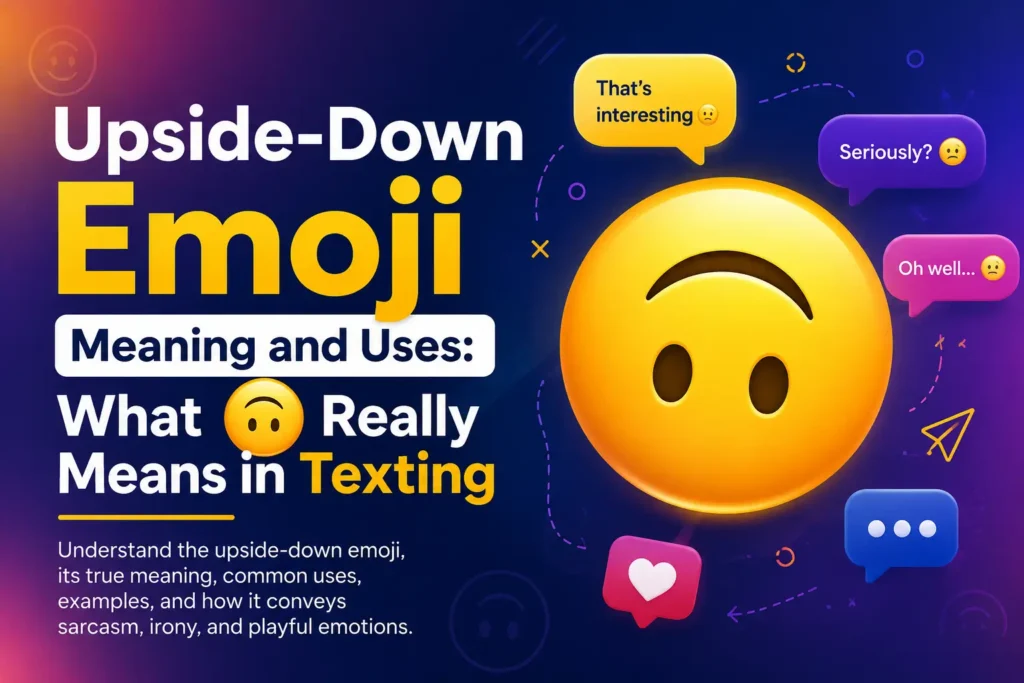

The upside-down emoji meaning and uses become clearer when you see how 🙃 changes the tone of a text. This emoji often adds sarcasm, irony, or playful frustration to messages. It can show hidden emotion, add humor, and make texting more expressive without long explanations. If you’ve received 🙃 and felt confused, the words may look normal, but this small symbol can completely change the feeling.
As emojis have evolved, 🙃 has become part of visual communication across WhatsApp, Instagram, SMS, and other platforms. Its meaning can vary by context, cultures, and generations. Among friends and family, it may make chats feel relaxed, while online it can suggest irony, teasing, or awkward humor.
A useful guide is to check the surrounding text messages before deciding its interpretation. The Upside Down Emoji Meaning may express embarrassment, playful annoyance, or ironic acceptance, depending on the sender’s intent, situation, relationship, and wording.
What Is the Upside-Down Face Emoji? 🙃
🙃 is a classic smiling face displayed upside down. On most platforms, it appears as an inverted version of the Slightly Smiling Face 🙂. Unicode lists it as Upside-Down Face, while Emojipedia describes its common uses as irony, sarcasm, joking, goofiness, and silliness.
The emoji doesn’t have one fixed emotional meaning. Instead, its tone changes according to the words around it. Someone might use it after a joke, an awkward moment, a small mistake, or an inconvenient situation.
Common interpretations include:
- Sarcasm
- Irony
- Playful humor
- Awkwardness
- Mild frustration
- Resignation
- Silliness
- Self-deprecating humor
- Forced positivity
- Playful passive-aggression
For that reason, the safest way to understand 🙃 is to read the entire message rather than interpreting the emoji on its own.
Read this also: White Heart Emoji Meaning : What It Means in Texting, Love & Social Media
What Does the Upside-Down Emoji Mean?
In simple terms, 🙃 often tells you that a message has an ironic, playful, awkward, or emotionally mixed tone.
Consider this message:
“Great. Another meeting at 7 a.m. 🙃”
The word “great” sounds positive. However, the upside-down smile suggests that the sender probably means the opposite. They aren’t celebrating the early meeting. Instead, they’re using humor to show mild frustration.
That same pattern appears in many everyday messages:
| Situation | Likely meaning of 🙃 |
|---|---|
| Something went wrong | “Well, that’s unfortunate.” |
| An ironic statement | “I don’t mean this literally.” |
| An embarrassing moment | “That was awkward.” |
| Minor annoyance | “I’m frustrated, but I’m laughing about it.” |
| Personal mistake | “Yep, I did that to myself.” |
| Bad luck | “Of course this happened to me.” |
| Teasing | “I’m messing with you.” |
| Uncomfortable situation | “I’m smiling through this.” |
| Casual sarcasm | “You know what I really mean.” |
Because text doesn’t include facial expressions or vocal tone, emojis can help readers interpret the intended mood. Still, 🙃 doesn’t replace context. The surrounding words remain the strongest clue.
The Official Unicode Meaning of 🙃
Unicode gives 🙃 its formal identity rather than defining every way people may use it in conversation.
The character U+1F643 is officially named UPSIDE-DOWN FACE. It appears in the Unicode Faces section alongside 🙂 Slightly Smiling Face and 🙄 Face With Rolling Eyes.
The emoji was approved under Unicode 8.0 in 2015 and became part of Emoji 1.0 in the same year. However, its history goes back further. Emojipedia reports that Google included an upside-down smiley in Gmail’s emoji set in 2008. (Emojipedia – The Latest Emoji News)
This distinction matters because Unicode gives the character a standardized name, while everyday users create additional meanings through repeated use. In other words, the official label tells you what the symbol is, while real conversations help explain what it can mean.
Why Does the Upside-Down Emoji Feel So Ironic?
The answer lies in the visual contrast.
A conventional smile usually suggests friendliness, pleasure, amusement, or positivity. Turn that same smile upside down, however, and it becomes unusual. The face still looks cheerful, but its position feels wrong.
That contradiction makes 🙃 useful for expressing mixed emotions.
For example:
“I accidentally sent the private message to the group chat 🙃”
The sender isn’t saying the mistake was good. Instead, the emoji softens the embarrassment and adds a little humor.
Emojipedia notes that 🙃 can convey a range of related feelings, including irony, awkwardness, frustration, ambivalence, and bemused resignation. It has also been described as an “emotional catch-all” because it can move between seemingly different emotional states.
Common Uses of the Upside-Down Emoji
Sarcasm and Irony
Sarcasm is one of the most familiar uses of 🙃.
Imagine a friend arriving 40 minutes late and writing:
“Wow, I’m so early today 🙃”
The sentence says one thing, while the situation says another. The emoji helps signal that the statement isn’t meant literally.
It works especially well with deliberately exaggerated statements:
- “I absolutely love sitting in traffic 🙃”
- “Nothing could possibly go wrong 🙃”
- “Another password reset. My favorite 🙃”
- “I really needed another deadline today 🙃”
In each case, 🙃 acts as a visual clue that the words contain an ironic meaning.
Playful Frustration
Not every use of 🙃 involves sarcasm. Sometimes it simply expresses mild frustration.
For example:
“The printer stopped working five minutes before my deadline 🙃”
The sender may be annoyed, but they aren’t necessarily angry. The emoji turns the complaint into something lighter.
In casual conversation, it can communicate:
“This is annoying, but I’m not going to lose my mind over it.”
That’s why the emoji often appears after minor problems, bad luck, delays, or everyday inconveniences.
Awkwardness and Social Discomfort
🙃 can also act like an awkward smile in a face-to-face conversation.
For example:
“Well… that got awkward 🙃”
Or:
“I waved back at someone who wasn’t waving at me 🙃”
Here, the emoji acknowledges the uncomfortable moment without making it overly serious.
Resigned Acceptance
Sometimes 🙃 means something close to “Oh well.”
Suppose your favorite restaurant is closed:
“The restaurant is closed, so I guess we’re getting pizza again 🙃”
The sender isn’t necessarily angry. Instead, they’re accepting the situation with a little humor.
Emojipedia specifically connects this use with bemused resignation.
Self-Deprecating Humor
People also use 🙃 when making fun of their own mistakes.
“I studied for three hours and forgot the formula on the test 🙃”
The emoji helps turn an embarrassing mistake into a humorous confession.
Other examples include:
- “I locked myself out again 🙃”
- “Forgot my own password. Brilliant 🙃”
- “I burned the toast while making breakfast 🙃”
In these cases, the tone is usually closer to “I’m laughing at myself” than genuine distress.
Forced Positivity and “Smiling Through It”
Another common use appears when someone pretends that everything is fine even though it clearly isn’t.
“Everything is going perfectly 🙃”
The sentence sounds positive, but the emoji creates an obvious contradiction.
Words: Everything is fine.
Emoji: Something is clearly not fine.
That contrast can make the message funny without requiring a long explanation.
Playful Passive-Aggression
Depending on the wording, 🙃 can sometimes make a message sound passive-aggressive.
For example:
“Sure, I’ll clean it up again 🙃”
That could mean:
- “No problem. I’m happy to help.”
- “I’m annoyed that I have to do this again.”
The emoji alone doesn’t determine which meaning applies. The relationship, previous conversation, and wording all matter.
So, although 🙃 can appear in passive-aggressive messages, it isn’t automatically passive-aggressive.
Upside-Down Emoji Meaning by Context
🙃 in Texting and Private Chats
Among friends, 🙃 usually feels casual and flexible. Someone might use it after describing a bad commute, making a silly mistake, or experiencing an awkward moment.
Because friends often understand each other’s communication habits, the emoji can carry a subtle meaning without needing an explanation.
🙃 on Social Media
On social media, 🙃 often appears in ironic captions, jokes, comments, and relatable observations.
For example:
“Me pretending I understand the new software update 🙃”
The emoji reinforces the joke by showing that the statement isn’t completely literal.
It can also turn everyday frustrations into shared humor:
“When your package says ‘delivered’ but there’s nothing outside 🙃”
Here, the emoji helps communicate frustration without making the post sound overly negative.
🙃 in Dating and Flirting
Is 🙃 a flirty emoji?
Not inherently.
Unlike 😏 Smirking Face, which can carry suggestive or flirtatious undertones, 🙃 doesn’t have a specifically romantic meaning. Emojipedia describes 🙃 primarily through irony, sarcasm, joking, silliness, and related tones.
Still, someone can use 🙃 while flirting.
For example:
“You really think you’re funny, don’t you? 🙃”
That could be playful teasing.
However, the same emoji could appear after an uncomfortable comment:
“That’s a very bold message 🙃”
In that situation, it may suggest uncertainty or awkwardness instead.
Therefore, don’t treat 🙃 by itself as proof of romantic interest. Look at the conversation as a whole.
🙃 at Work
Workplace use deserves more care because humor can become ambiguous quickly.
In a casual team chat, someone might write:
“The meeting moved to 7:30 a.m. 🙃”
The team may understand the joke immediately.
However, sending the same emoji to a manager after receiving criticism could make your attitude unclear. The recipient might wonder whether you’re joking, frustrated, or being sarcastic.
For messages involving the following topics, clear wording is usually safer:
- Performance concerns
- Client communication
- Complaints
- Deadlines
- Conflict
- Serious requests
A professional message should make the intended meaning obvious rather than forcing the reader to interpret an emoji.
What Does 🙃 Mean From Different People?
When a Friend Sends 🙃
A friend may use 🙃 to say:
“This situation is ridiculous.”
It could signal frustration, embarrassment, sarcasm, or simple silliness. The surrounding conversation usually gives you the clues.
Read this also: What Does the Snowflake Emoji Really Mean?
When a Crush or Partner Sends 🙃
The meaning depends heavily on the relationship and the conversation.
After playful teasing, 🙃 may reinforce the joke. After an awkward comment, it could signal embarrassment. Following canceled plans, it might suggest disappointment.
For example:
“Sure, maybe next weekend 🙃”
That could express playful resignation, genuine disappointment, or both.
The emoji alone can’t settle the question.
When a Coworker or Boss Sends 🙃
A coworker might use 🙃 to make a stressful situation feel lighter:
“Looks like the report needs another revision 🙃”
With a boss, however, the same symbol can feel more ambiguous because of the professional relationship. When there’s a power difference, straightforward language is usually the better choice.
🙃 Meaning in Real Texting Examples
Context can change the tone dramatically, even when the same emoji appears at the end.
| Text | Likely meaning |
|---|---|
| “I forgot my keys again 🙃” | Self-deprecating humor |
| “Great, another flat tire 🙃” | Frustrated resignation |
| “I love being stuck in traffic 🙃” | Sarcasm |
| “That was not awkward at all 🙃” | Irony |
| “Sure, I’ll do it again 🙃” | Possible passive-aggression |
| “You actually said that? 🙃” | Teasing or disbelief |
| “Everything is totally fine 🙃” | Ironic forced positivity |
Notice the pattern: the words establish the situation, while 🙃 often adds the emotional subtext.
How to Tell What 🙃 Means in a Specific Message
When you’re unsure about an upside-down emoji meaning, don’t rely on a universal definition. Instead, look at several clues.
- Read the sentence first. The wording gives you the basic meaning.
- Check the previous message. It may explain why the sender used 🙃.
- Consider the relationship. Friends, coworkers, partners, and strangers may use the same emoji differently.
- Notice the sender’s habits. Some people use 🙃 frequently, while others use it rarely.
- Look at nearby emojis. Another emoji can change the overall tone.
- Pay attention to punctuation. “Okay 🙃” can feel different from “LOL 🙃.”
- Consider the situation. A canceled plan may produce a different interpretation than a funny story.
Taken together, these clues give you a much more reliable interpretation than the emoji alone.
What 🙃 Does Not Necessarily Mean
Several assumptions about 🙃 can lead to misunderstandings.
It doesn’t always mean sarcasm. Sarcasm is common, but the emoji can also express silliness, awkwardness, frustration, or resignation.
It isn’t automatically passive-aggressive. Someone may simply be making fun of an annoying situation.
It isn’t automatically flirty. Romantic meaning comes from the broader conversation rather than the emoji itself.
It doesn’t always mean sadness. Someone can use it while joking about an ordinary inconvenience.
It doesn’t have one universal emotional definition. Emoji meaning develops through actual communication and context.
That’s why a dictionary-style definition can only take you so far.
🙃 vs. Similar Face Emojis
Comparing 🙃 with similar expressions makes its tone easier to recognize.
| Emoji | Common tone | Main difference from 🙃 |
|---|---|---|
| 🙂 | Mild friendliness | More straightforward |
| 😅 | Nervousness or relief | Focuses more on nervous laughter |
| 😬 | Awkwardness or tension | Usually feels more uncomfortable |
| 😏 | Smugness or flirtation | More suggestive or self-assured |
| 😐 | Neutrality | Doesn’t carry the same ironic contrast |
| 😵💫 | Confusion or overwhelm | Suggests stronger mental overload |
| 😂 | Genuine amusement | More directly signals laughter |
The distinction between 🙃 and 🙂 is especially important. 🙂 presents a conventional slight smile, while 🙃 deliberately turns that smile upside down.
Likewise, 🙃 and 😏 can overlap in playful conversations, but they aren’t interchangeable. 🙃 is more closely associated with irony and awkward humor, while 😏 can suggest smugness or flirtation.
When Should You Avoid Using the Upside-Down Emoji?
Formal or Professional Communication
Avoid 🙃 when your message requires absolute clarity.
For example, telling a client:
“We’ll try to finish that today 🙃”
could make your commitment sound uncertain or sarcastic.
A direct statement is much safer:
“We’ll send the completed report today.”
Serious or Sensitive Conversations
An ironic emoji can make a serious message sound dismissive.
If someone is discussing grief, conflict, financial difficulties, or another sensitive subject, humor may not communicate the empathy you intend.
When You Need to Express Clear Anger or Concern
If you’re genuinely upset, direct language is usually better than an ambiguous emoji.
🙃 is useful because it adds shades of meaning. However, that flexibility becomes a weakness when the reader needs a clear answer.
Sometimes the best message is simply the clearest one.
How to Reply to 🙃
Your response should match the situation.
Neutral Reply
If you’re unsure what the sender means:
“Everything okay?”
This gives them a chance to explain without assuming anything.
Playful Reply
If the conversation is clearly humorous:
“😂 Not again.”
Or:
“You really can’t catch a break.”
Clarifying Reply
If the message could indicate genuine frustration:
“Are you annoyed, or are you joking?”
A direct question may feel slightly unusual, but it can prevent a misunderstanding.
Common Misconceptions About the Upside-Down Emoji
Myth: 🙃 always means “I’m unhappy.”
Not necessarily. It can be playful, silly, ironic, or resigned.
Myth: 🙃 is always passive-aggressive.
No. The wording and context determine whether the message feels pointed.
Myth: 🙃 is a secret flirting signal.
No. It can appear during flirting, but it isn’t inherently romantic.
Myth: 🙃 has only one meaning.
Its everyday uses cover several related tones.
Myth: The emoji matters more than the words.
Usually, the safer approach is the opposite. Read the message first, then use the emoji to refine your interpretation.
Read this also: Brown Heart Emoji Meaning: What Does Mean in Texting?
Why Context Matters More Than the Emoji
Consider this message:
“I got another parking ticket 🙃”
Most readers would probably interpret it as frustration mixed with humor.
Now compare it with:
“You remembered my birthday 🙃”
That could sound playful, teasing, or affectionate.
The emoji hasn’t changed.
The context has.
That’s the key to understanding 🙃. It isn’t a word with one strict dictionary definition. Instead, it acts as a tone signal that gains meaning from the sentence around it.
Emojipedia describes 🙃 as having a broad emotional range and notes its recurring connection with irony.
Frequently Asked Questions
The 🙃 emoji commonly expresses sarcasm, irony, awkwardness, playful frustration, or resignation. Its exact meaning depends on the conversation.
Yes, 🙃 is often used for sarcasm and irony. It can make a statement sound less literal or show that the sender means the opposite of the words.
Not necessarily. 🙃 isn’t specifically a flirty emoji. Someone may use it while flirting, but the surrounding conversation provides the real context.
It can mean sarcasm, teasing, awkwardness, frustration, or playful humor. The sender’s gender doesn’t determine the emoji’s meaning.
A guy may use 🙃 to express irony, joking, mild annoyance, awkwardness, or resignation. You need to consider the complete message.
Sometimes, but not always. A message such as “Sure, I’ll do it again 🙃” may sound passive-aggressive, while other uses are simply humorous.
Friends commonly use 🙃 to make an annoying, embarrassing, or ridiculous situation feel lighter. It can also signal playful sarcasm.
In relationships, 🙃 may express teasing, awkwardness, mild frustration, or playful irony. It doesn’t automatically indicate affection or anger.
Use 🙃 in casual conversations when you want to add irony, humor, awkwardness, or mild frustration. Avoid it when your message needs serious or professional clarity.
🙂 usually communicates a straightforward, mild smile. 🙃 turns the smile upside down and often adds irony, awkwardness, sarcasm, or playful frustration.
Conclusion
The upside-down emoji 🙃 adds a playful layer to everyday communication. It can show sarcasm, irony, awkwardness, mild frustration, teasing, or resigned humor, depending on the message around it. Its meaning isn’t fixed, so context matters more than the emoji alone. Whether you’re texting a friend, replying on social media, or chatting with family, look at the words, situation, and relationship before deciding what 🙃 means.