
The Current Phase of the Moon as an Emoji: Today’s Moon Phase, Meaning & Copy-Paste Symbols connects the real moon and sky with digital communication. The moon cycle has eight phases, including the new moon, full moon, crescent moon, and half moon.
You can use apps to check today’s moon phase, compare the moon’s shape, and choose the right moon emoji.Remember, the current moon phase emoji isn’t automatic or live. Instead, use the matching emoji symbol that best represents the lunar phase you see in the night sky.Unused words.
posts, post, chat, photos, moon stages, moon emojis, messages, right emoji, moon phase, moon symbol, moon cycle stages, emoji symbol, month, shape, lunar changes, moon changes, astronomy, visual symbol, moon above you, correct emoji, correct symbol, accurate, meaningful, different moon emoji, changes, special, connected, emoji, astronomical display
What Is the Current Phase of the Moon as an Emoji?
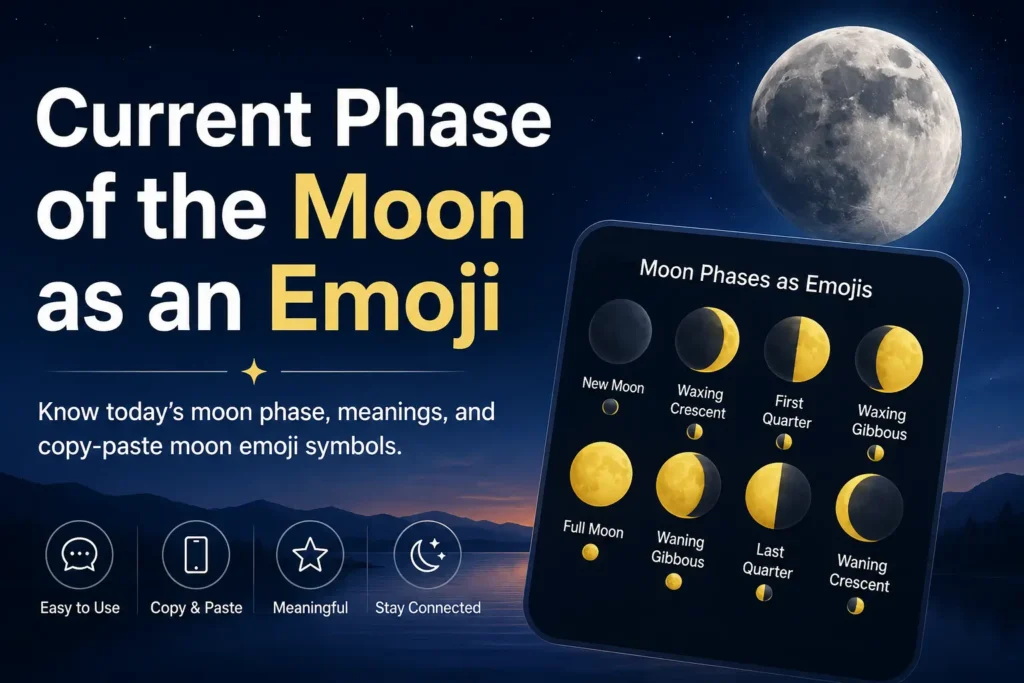
A Moon-phase emoji represents one of the eight commonly recognized stages of the lunar cycle. These stages begin with the new Moon, progress through the waxing crescent and quarter phases, reach the full Moon, and then move through the waning stages before returning to new Moon.
However, a Moon emoji isn’t a live astronomical indicator. Your phone doesn’t automatically replace 🌕 with 🌖 when the real Moon begins to wane. Instead, you select the symbol that best matches the actual lunar phase.
| Lunar phase | Emoji | What it represents |
|---|---|---|
| New Moon | 🌑 | Little or no visible illumination |
| Waxing Crescent | 🌒 | A growing illuminated crescent |
| First Quarter | 🌓 | About half of the visible disk illuminated |
| Waxing Gibbous | 🌔 | More than half illuminated and growing |
| Full Moon | 🌕 | The Moon appears fully illuminated |
| Waning Gibbous | 🌖 | More than half illuminated but decreasing |
| Last Quarter | 🌗 | About half of the visible disk illuminated |
| Waning Crescent | 🌘 | A shrinking illuminated crescent |
These symbols make lunar information easy to recognize in messages, social posts, captions, and other digital communication.
Read this also: Brown Heart Emoji Meaning: What Does Mean in Texting?
Does the Moon Phase Emoji Change Automatically?
No. Moon emojis are static Unicode characters, not dynamic astronomical displays.
When you send 🌔, the recipient receives that particular Unicode character. Their device may display slightly different artwork, but the underlying character remains the same.
Therefore, you can use 🌔 even when the actual Moon isn’t waxing gibbous. The emoji doesn’t check the date, location, illumination percentage, or Moon’s position before appearing.
That’s why an accurate Moon-phase post should work in two steps:
- Check the actual Moon phase.
- Choose the closest matching emoji.
This small distinction prevents a common mistake: assuming that a Moon emoji automatically represents the Moon visible outside your window.
How to Find Today’s Actual Moon Phase
The Moon doesn’t change between its eight phases instantly. Its illuminated appearance gradually shifts as it orbits Earth.
Astronomers commonly describe the lunar cycle using eight phases over a cycle of approximately 29.5 days. The Sun always illuminates roughly half of the Moon. What changes from Earth is how much of that illuminated portion we can see.
To identify today’s Moon phase, check a reliable lunar calendar or astronomy app. Look for:
- Current lunar phase
- Illumination percentage
- Moonrise and moonset
- Local date and time
- Next quarter or full/new Moon
- Your viewing location
Location becomes particularly useful when you want to know when the Moon will appear above the horizon. The physical lunar phase is shared across Earth at a given moment, but viewing times vary by location.
How to Match Today’s Moon Phase to the Right Emoji
Matching the real Moon to an emoji is easier when you focus on two things: shape and direction of change.
First, look at how much of the Moon appears illuminated. Next, determine whether that illuminated portion is increasing or decreasing.
If the illuminated portion is growing, the Moon is waxing. If it’s shrinking, the Moon is waning.
For example, a Moon that appears more than half illuminated while moving toward full Moon corresponds most closely to 🌔 Waxing Gibbous. After full Moon, a similar-looking but decreasing Moon corresponds to 🌖 Waning Gibbous.
The emoji gives you a convenient shorthand. An astronomy tool provides the precise information behind it.
The 8 Moon Phase Emojis Explained
🌑 New Moon Emoji
The 🌑 New Moon marks the beginning of the commonly used lunar-phase sequence.
During this phase, the side of the Moon facing Earth receives very little direct sunlight from our viewing perspective. As a result, the Moon generally becomes difficult to see.
The new Moon is also important because it begins another cycle of waxing illumination.
🌒 Waxing Crescent Emoji
The 🌒 Waxing Crescent represents the early stage after new Moon.
Here, the visible illuminated portion begins to grow. The crescent remains relatively narrow, but more of the lunar surface becomes visible as the days pass.
This emoji works well when you’re referring to a growing crescent in the evening sky or discussing the early lunar cycle.
🌓 First Quarter Emoji
The 🌓 First Quarter represents a Moon that appears roughly half illuminated.
Despite the phrase “half Moon,” the entire Moon isn’t actually half lit. Sunlight illuminates about half of the lunar surface at any given time. From Earth, we see different portions of that illuminated half throughout the lunar cycle.
The first quarter occurs during the waxing half of the cycle.
🌔 Waxing Gibbous Emoji
The 🌔 Waxing Gibbous appears after the first quarter and before full Moon.
“Gibbous” describes a Moon that looks more than half illuminated but isn’t full. During the waxing gibbous stage, the visible illuminated area continues increasing.
This symbol is useful when you want to represent a nearly full but still growing Moon.
🌕 Full Moon Emoji
The 🌕 Full Moon is the most recognizable lunar-phase symbol.
At full Moon, the side facing Earth is broadly illuminated by sunlight, making the lunar disk appear bright and round.
People commonly use 🌕 for astronomy posts, nighttime messages, lunar photography, and references to the full Moon. Its visual simplicity also makes it popular in decorative digital communication.
🌖 Waning Gibbous Emoji
The 🌖 Waning Gibbous represents the phase immediately following the full Moon.
The Moon still appears more than half illuminated, but the visible illuminated portion is now decreasing. This is where the word waning becomes important.
If you see a nearly full Moon that is gradually losing visible illumination, 🌖 is the closest standard phase emoji.
🌗 Last Quarter Emoji
The 🌗 Last Quarter occurs after the waning gibbous stage.
Like the first quarter, it appears roughly half illuminated. The difference lies in its position within the lunar cycle: first quarter occurs while the Moon is waxing, while last quarter occurs during the waning half.
This makes 🌓 and 🌗 easy to confuse unless you consider the direction of the lunar cycle.
🌘 Waning Crescent Emoji
The 🌘 Waning Crescent represents the final visible crescent before the next new Moon.
Only a relatively small portion of the lunar disk appears illuminated. As the cycle approaches new Moon, that visible crescent becomes increasingly narrow.
Use 🌘 when you want to show the shrinking crescent rather than the growing crescent represented by 🌒.
Moon Phase Emoji vs. Other Moon Emojis
Not every Moon-related emoji represents a specific lunar phase.
For example, 🌙 Crescent Moon is a general Moon symbol. It can communicate nighttime, a crescent, sleep, or a celestial theme without identifying a precise astronomical phase.
Other Moon-related symbols include:
- 🌚 New Moon Face
- 🌛 First Quarter Moon Face
- 🌜 Last Quarter Moon Face
- 🌝 Full Moon Face
- 🌙 Crescent Moon
The face emojis add personality and expression. By contrast, 🌑 through 🌘 form the more useful sequence when you want to identify a particular lunar phase.
So, if you’re writing about astronomy, choose the phase-specific symbol when possible. For casual texting, however, 🌙 may be all you need.
Why Moon Emojis Don’t Precisely Match the Real Moon
A Moon emoji is a visual symbol, not an astronomical photograph.
The actual Moon changes gradually. Its appearance also depends on viewing conditions, orientation, atmospheric clarity, and where you are observing it from.
Emoji artwork simplifies that appearance into a standardized character. As a result, an emoji can’t communicate an exact illumination percentage or reproduce every detail visible through binoculars or a telescope.
There’s another interesting consideration: hemisphere.
The Moon’s visual orientation differs between the Northern and Southern Hemispheres. Consequently, the way someone interprets the illuminated side can vary depending on where they’re standing.
For everyday communication, this usually doesn’t matter. Still, it’s worth remembering when using Moon emojis for precise astronomy content.
Moon Emojis on iPhone, Android, Windows, and Other Platforms
The same Unicode Moon emoji can look different across devices.
Apple, Google, Microsoft, and other platforms create their own emoji artwork. One version may use more texture, while another may use a simpler design. The illuminated area may also appear slightly different visually.
Nevertheless, the underlying Unicode character remains the same.
That means a 🌕 sent from one device is still the same Unicode symbol when viewed on another platform, even if the artwork isn’t identical.
Moon Emojis and Their Meanings in Texting and Social Media
Moon emojis can carry both literal and emotional meanings.
In a message such as:
“Good night 🌙”
the Moon simply reinforces the nighttime setting.
Meanwhile:
“The full Moon looks incredible tonight 🌕”
uses the emoji more literally.
Depending on context, Moon symbols can also suggest:
- Nighttime
- Dreams
- Calmness
- Mystery
- Romance
- Nature
- Beauty
- Astronomy
- A peaceful mood
There isn’t one universal hidden meaning for every Moon emoji. The surrounding message usually determines how readers interpret it.
Waxing vs. Waning Moon Emojis: How to Tell the Difference
The simplest distinction is:
Waxing means increasing illumination.
Waning means decreasing illumination.
The sequence makes this easier to remember:
🌑 → 🌒 → 🌓 → 🌔 → 🌕 → 🌖 → 🌗 → 🌘 → 🌑
The first portion moves toward full Moon. The second portion moves away from it.
| Direction | Moon phases |
|---|---|
| Waxing | 🌒 → 🌓 → 🌔 |
| Full | 🌕 |
| Waning | 🌖 → 🌗 → 🌘 |
A useful memory trick is to think of waxing as adding visible light and waning as losing visible light.
Astronomy vs. Astrology: What Moon Emojis Actually Represent
Astronomy and astrology both discuss the Moon, but they approach it differently.
Astronomy studies the Moon as a physical celestial body. Lunar phases result from the changing positions of the Sun, Earth, and Moon.
Astrology, meanwhile, assigns symbolic interpretations to lunar positions and phases.
Moon emojis can appear in either setting. For instance, 🌕 can represent an actual full Moon in an astronomy discussion. The same emoji might symbolize completion or another concept in an astrological context.
Keeping these meanings separate makes your content clearer. Scientific descriptions should remain distinct from symbolic interpretations.
How Accurate Is a Moon Phase Emoji?
A Moon-phase emoji can communicate the general phase effectively. It can’t provide the precision of an astronomical calculator.
An emoji doesn’t tell you the exact:
- Illumination percentage
- Moonrise time
- Moonset time
- Lunar distance
- Position in the sky
- Angular relationship with the Sun
For example, two dates can both fall within the waning gibbous stage while having noticeably different illumination percentages.
Therefore, use the emoji for communication and a Moon-phase tracker for precision.
Moon Phase Emoji Quick Reference Chart
| Emoji | Phase | Best use |
|---|---|---|
| 🌑 | New Moon | Dark lunar phase |
| 🌒 | Waxing Crescent | Growing crescent |
| 🌓 | First Quarter | Waxing half-lit Moon |
| 🌔 | Waxing Gibbous | Growing Moon before full |
| 🌕 | Full Moon | Fully illuminated appearance |
| 🌖 | Waning Gibbous | Shrinking Moon after full |
| 🌗 | Last Quarter | Waning half-lit Moon |
| 🌘 | Waning Crescent | Shrinking crescent |
For quick copy and paste:
🌑 🌒 🌓 🌔 🌕 🌖 🌗 🌘
For general Moon imagery:
🌙 🌚 🌛 🌜 🌝
How to Copy and Paste Moon Phase Emojis
If you simply need the Moon-phase symbols, you can copy them directly:
🌑 New Moon
🌒 Waxing Crescent
🌓 First Quarter
🌔 Waxing Gibbous
🌕 Full Moon
🌖 Waning Gibbous
🌗 Last Quarter
🌘 Waning Crescent
These symbols work across many modern phones, computers, messaging services, and social platforms.
Remember that the visual design can vary from one device to another. The underlying emoji character remains unchanged.
Read this also: Pre vs Post: Meaning, Difference, Usage & Examples
Common Mistakes When Choosing a Moon Phase Emoji
A few mistakes can make a Moon-related post misleading.
Assuming 🌙 means today’s exact phase:
The crescent Moon emoji is general-purpose. It isn’t a live phase indicator.
Confusing 🌒 and 🌘:
Both show crescents, but 🌒 represents waxing while 🌘 represents waning.
Mixing up 🌓 and 🌗:
Both appear approximately half illuminated, yet they occur at different points in the cycle.
Expecting automatic updates:
Your phone won’t change Moon emojis according to the actual lunar cycle.
Treating emoji artwork as a scientific image:
Platform artwork is symbolic rather than a precise astronomical rendering.
Mixing astronomy with symbolism:
A Moon emoji can have a cultural or emotional meaning without changing its scientific definition.
Moon Phase Emoji FAQs
The closest emoji depends on the Moon’s actual phase. Check today’s lunar phase first, then choose the matching symbol from 🌑, 🌒, 🌓, 🌔, 🌕, 🌖, 🌗, or 🌘.
No. Moon emojis are static Unicode symbols. Your phone doesn’t automatically change 🌕 to 🌖 when the real Moon moves into another phase.
The 🌕 Full Moon emoji represents the full Moon phase. It’s commonly used for astronomy, nighttime posts, lunar events, and general Moon-related messages.
🌒 represents a waxing crescent, while 🌘 represents a waning crescent. Waxing means the visible illuminated portion is growing, while waning means it’s shrinking.
🌓 represents the first quarter, while 🌗 represents the last quarter. Both show roughly half of the visible Moon illuminated, but they occur at different points in the lunar cycle.
🌙 is a general Crescent Moon symbol rather than a precise live indicator. If you want to represent a specific lunar phase, use the corresponding phase emoji instead.
First, check the actual lunar phase using a reliable Moon-phase calendar or astronomy app. Then compare the Moon’s appearance with the eight standard phase emojis and choose the closest match.
Final Takeaway: Choosing the Right Moon Emoji
The Current Phase of the Moon as an Emoji makes it easy to represent the Moon in digital communication. The eight main phase emojis, from 🌑 to 🌘, can visually match the major stages of the lunar cycle. However, these symbols don’t update automatically with the real Moon. For the most accurate choice, check today’s lunar phase first, then select the emoji that best matches what you see.