
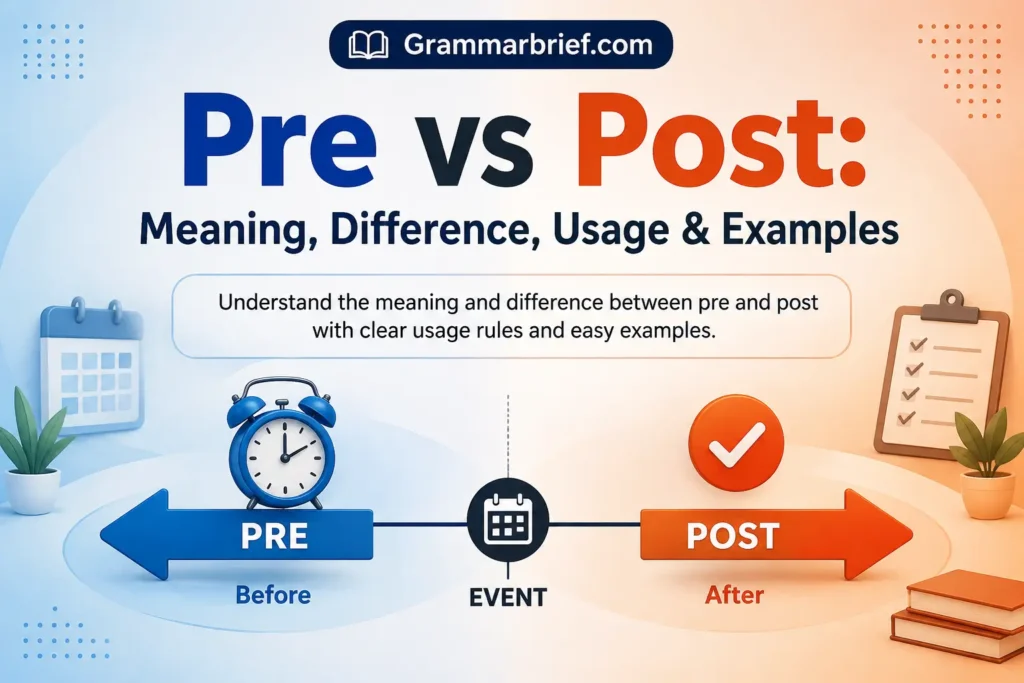

In English, pre vs post helps explain how the meaning of a word can significantly change with a prefix. Pre means before, while post means after. A simple timeline makes the difference clear: pre happens before an event, and post happens after an event. For example, a pretest happens before instruction, while a postgame review follows a game.
This timing helps establish the correct order of events in school, work, and daily conversations. In real-life situations, these commonly used prefixes help clarify what is happening. Pre often relates to planning, instructions, and preparation, while post relates to results, follow-up, and later actions. The before and after test makes this common problem easier: identify the main event, decide whether it happens before or after, then choose the right prefix.
Experienced writers use this simple method to convey the exact meaning clearly. With learning, understanding, and practice, you can use these tricky prefixes correctly and avoid common mistakes. These small words can make a big difference in reading and writing.
Pre vs Post at a Glance
The easiest way to understand these prefixes is to focus on time or sequence.
| Prefix | Basic meaning | Time relationship | Example |
| pre- | before | Earlier than an event | pretest |
| post- | after | Later than an event | posttest |
| pre- | in advance | Before something happens | prepayment |
| post- | afterward | Following something | postpayment |
Cambridge defines pre- as meaning “before” a time or event and gives examples such as pre-flight and pre-lunch. Its dictionary defines post- as meaning “after or later than,” with examples including postgraduate and postoperative.
So, when you see pre-, think earlier. When you see post-, think later.
Quick rule: Pre comes before. Post comes after.
That simple rule handles most everyday uses.
Read this also:To Short or Too Short? Grammar Explained With Examples
What Does Pre Mean?
Pre- is a prefix that generally means before, earlier than, or in advance of something. It can describe a time, event, condition, process, or preparation stage.
For example:
- Preheat = heat something before using it.
- Prepay = pay before receiving something.
- Preorder = order something before it becomes available.
- Preview = view something before the main presentation or release.
- Pretest = a test given before instruction or another assessment.
- Preexisting = existing beforehand.
The prefix can also express preparation. A preflight check, for instance, takes place before a flight begins. A preoperative examination happens before surgery.
Merriam-Webster also identifies several related senses of pre-, including “earlier than,” “preparatory or prerequisite to,” “in advance,” and “in front of.”
How Pre- Changes a Word
The base word tells you what is happening. The prefix tells you when it happens.
Consider this pattern:
payment → prepayment
The word payment describes the action. Adding pre- tells you that the payment occurs beforehand.
Another example:
view → preview
A preview gives you an earlier look before the full material appears.
That timing shift is the key to understanding pre-.
What Does Post Mean?
Post- is a prefix that generally means after, later than, or following an event or period.
Common examples include:
- Posttest = a test given afterward.
- Postgraduate = relating to study after an undergraduate degree.
- Postoperative = occurring after an operation.
- Postwar = relating to the period after a war.
- Postproduction = work performed after the main production stage.
- Post-election = occurring after an election.
For example, a doctor may discuss postoperative care after surgery. A filmmaker may work on postproduction after filming ends.
Cambridge specifically lists postgraduate, postoperative, and post-lunch as examples of the prefix’s meaning “after or later than.”
How Post- Changes a Word
Just as pre- moves an idea backward on a timeline, post- moves it forward.
For example:
test → posttest
The prefix doesn’t simply change the subject. It establishes the test’s position after an earlier event or stage.
Likewise:
war → postwar
A postwar period refers to the time following a war.
Pre vs Post: What’s the Difference?
The central distinction is straightforward:
Pre- = before.
Post- = after.
However, understanding the timeline behind each word makes the rule much more useful.
| Question | Pre- | Post- |
| What does it mean? | Before | After |
| What does it describe? | An earlier stage or condition | A later stage or condition |
| Where does it sit on a timeline? | Before the anchor event | After the anchor event |
| Common idea | Preparation | Follow-up |
| Example | pretest | posttest |
| Another example | prelaunch | postlaunch |
Imagine a product launch as the anchor event.
Before launch, the company handles prelaunch activities. After launch, it studies postlaunch results.
The same logic works almost everywhere.
Why the Anchor Event Matters
A prefix such as pre- or post- needs something to establish the timeline.
In preoperative, the anchor is the operation.
In postoperative, the anchor is still the operation.
In pre-election, the anchor is the election.
In post-election, that same election provides the reference point.
This makes the terms easier to interpret even when you encounter an unfamiliar word.
Pre and Post on a Timeline
A timeline offers one of the fastest ways to remember these prefixes:
PRE → EVENT → POST
Suppose a university gives students an assessment before a course begins.
Pretest → Course → Posttest
The first assessment establishes what students know before instruction. The second measures knowledge afterward.
Consider another example:
Preoperative care → Surgery → Postoperative care
Here, the operation acts as the anchor event. Everything before it falls into the pre- stage. Everything afterward belongs to the post- stage.
This approach works because both prefixes express a relationship in time rather than merely describing an object.
How Pre- and Post- Work as Prefixes
A prefix is a word-forming element placed at the beginning of another word or base. Prefixes can modify meaning by expressing relationships such as time, place, direction, quantity, or negation.
With pre- and post-, the relationship often concerns time.
How Pre- Changes Meaning
The basic pattern is:
pre- + base word = before the base word’s event or state
Examples include:
- pre + heat → preheat
- pre + pay → prepay
- pre + view → preview
- pre + war → prewar
- pre + existing → preexisting
The resulting word can describe preparation, timing, or an earlier state.
How Post- Changes Meaning
The basic pattern becomes:
post- + base word = after the base word’s event or state
Examples include:
- post + war → postwar
- post + graduate → postgraduate
- post + operative → postoperative
- post + production → postproduction
- post + election → post-election
English uses both prefixes productively, although not every base word naturally forms a standard pair.
Pre vs Post Examples in Everyday English
These prefixes appear in ordinary communication more often than you might expect.
Pre- Examples
Preheat the oven means to heat the oven before cooking.
Prepay the bill means to pay before the relevant service or period.
Preorder the book means to order it before its official availability.
Preview the presentation means to see it beforehand.
Preplanned activities are activities arranged in advance.
Post- Examples
Postgame analysis takes place after a game.
Postwar reconstruction occurs after a war.
Postpayment refers to payment made afterward.
Postproduction editing happens after the primary production stage.
Post-election coverage examines events following an election.
Pre and Post in Complete Sentences
The difference becomes clearer when both appear in realistic sentences:
- The team held a prelaunch meeting before releasing the product.
- The marketing department conducted a postlaunch review afterward.
- Students completed a pretest before the lesson.
- The teacher administered a posttest after instruction.
- Nurses provided preoperative preparation before surgery.
- The hospital monitored the patient during postoperative recovery.
Notice the pattern. The prefixes don’t merely decorate the words. They establish where something falls in a sequence.
Pre vs Post in Different Contexts
Education
Education uses these prefixes to distinguish measurements or activities performed at different stages.
Common examples include:
- pretest
- posttest
- preassessment
- postassessment
- pre-class
- post-class
- pre-course
- post-course
A pretest can establish a learner’s starting point. A posttest can then show what changed after instruction.
This distinction matters in educational research because researchers often compare measurements taken before and after an intervention.
Healthcare and Medicine
Medical terminology uses pre- and post- extensively.
Examples include:
| Before | After |
| prenatal | postpartum |
| preoperative | postoperative |
| pretreatment | post-treatment |
| preprocedure | postprocedure |
| preoperative assessment | postoperative monitoring |
For example, prenatal refers to the period before birth. Postpartum describes the period following childbirth.
Similarly, preoperative relates to the period before an operation, while postoperative relates to the period afterward.
In medical writing, this distinction can carry significant practical meaning because timing often affects treatment, monitoring, instructions, and expected outcomes.
Business and Work
Businesses use these prefixes when describing stages around launches, meetings, campaigns, sales, and projects.
Examples include:
- prelaunch planning
- postlaunch analysis
- premeeting preparation
- postmeeting follow-up
- presale activity
- postsale support
- pre-project planning
- post-project review
Imagine a company releasing a new product.
Before launch, employees may conduct market research, finalize pricing, test messaging, and prepare sales materials. Those activities belong to the prelaunch stage.
After launch, the company may review customer feedback, sales results, and campaign performance. That’s the postlaunch stage.
Technology and Digital Workflows
Technology provides some of the clearest examples of the pre/post distinction.
Preprocessing and Postprocessing
Preprocessing prepares raw information before the main operation.
Postprocessing handles information after the primary operation has finished.
For example, a digital imaging workflow might include:
Raw data → Preprocessing → Main processing → Postprocessing → Final output
The terms don’t describe identical activities. They identify different stages in a workflow.
Preproduction and Postproduction
Media production follows a similar structure.
Preproduction may involve planning, scripting, scheduling, casting, and preparation.
Production involves the primary recording or creation stage.
Postproduction can include editing, sound work, visual effects, color correction, and final assembly.
Research and Data Analysis
Research frequently compares conditions before and after an intervention.
A study might collect pre-intervention measurements and compare them with post-intervention measurements.
Researchers may also use terms such as:
- pretest
- posttest
- pre-treatment
- post-treatment
- pre-intervention
- post-intervention
- pre-analysis
- post-analysis
The exact terminology depends on the research design. However, the underlying idea remains the same: the prefix identifies when the measurement or activity occurs relative to an anchor point.
Common Pre- and Post- Word Pairs
Some combinations appear frequently enough to learn as pairs.
| Pre-Word | Meaning | Post-Word | Meaning |
| pretest | before a test or instruction stage | posttest | after a test or instruction stage |
| prewar | before a war | postwar | after a war |
| preoperative | before surgery | postoperative | after surgery |
| prelaunch | before launch | postlaunch | after launch |
| preproduction | before primary production | postproduction | after primary production |
| preprocessing | before main processing | postprocessing | after main processing |
| prepayment | payment made beforehand | postpayment | payment made afterward |
| pre-election | before an election | post-election | after an election |
These pairs make excellent vocabulary anchors because you can learn both meanings simultaneously.
How to Use Pre and Post Correctly in Sentences
Choosing the right prefix usually takes only a few logical steps.
Step 1: Identify the Main Event
First, ask: What event or stage provides the reference point?
For postoperative, the operation is the reference point.
For post-election, the election is the reference point.
Step 2: Ask Whether It Happens Before or After
Next, determine the timing.
If the activity occurs beforehand, pre- may be appropriate.
If it occurs afterward, post- may be appropriate.
Step 3: Choose Pre- or Post-
Attach the prefix to the relevant word or expression when standard English uses that formation.
For example:
- before launch → prelaunch
- after launch → postlaunch
Step 4: Check the Standard Form
Don’t assume every prefixed word follows the same spelling pattern.
Some forms appear as single words. Others use a hyphen.
Step 5: Read the Sentence for Clarity
Finally, make sure the wording clearly communicates the intended timeline.
If the reader could reasonably interpret the timing in two ways, rewrite the sentence.
Pre vs Post and Hyphenation
Hyphenation causes more confusion than the meanings themselves.
There isn’t one universal rule that says every pre- or post- word needs a hyphen. Cambridge notes that there are no absolute rules for every prefixed form and recommends checking a reliable learner’s dictionary for individual words.
Common forms include:
- preheat
- prepay
- preexisting
- postwar
- postgraduate
- postoperative
Hyphenated forms also occur, particularly when the structure improves readability or when a word is being formed around a phrase, abbreviation, number, or proper noun.
Examples include:
- pre-election
- post-election
- pre-9/11
- post-9/11
The safest approach is simple: don’t add a hyphen automatically. Check the established spelling of the specific word.
Common Mistakes With Pre and Post
Mistake 1: Reversing Before and After
The most basic error is confusing the timeline.
Incorrect thinking:
post = before
Correct:
pre = before
post = after
Mistake 2: Treating Pre and Post as Interchangeable
They aren’t interchangeable because they establish opposite chronological relationships.
A pretest and a posttest may look similar, but they happen at different stages.
Changing the prefix changes the meaning.
Mistake 3: Adding a Prefix When It Isn’t Needed
Not every sentence needs a technical-looking pre- or post- construction.
Sometimes plain English works better.
Instead of forcing a complicated formation, you can simply say before the meeting or after the meeting when that wording feels clearer.
Good writing prioritizes clarity rather than making every sentence sound technical.
Mistake 4: Using an Incorrect Hyphen
Avoid assuming that every prefixed word needs a hyphen.
For example, established forms such as preheat and postwar are normally written as single words.
Mistake 5: Assuming Every Pre- Word Has a Post- Opposite
This is an important point.
Although pre- and post- often create useful contrasts, they don’t form automatic antonyms with every word.
For instance, English has preview, but postview isn’t a standard everyday counterpart with the same meaning.
Likewise, prehistoric doesn’t simply pair with a standard word formed by replacing pre- with post-.
So, treat the prefixes as meaning-bearing elements rather than an automatic word-pair generator.
Are Pre and Post True Opposites?
In terms of time, pre- and post- often point in opposite directions.
One points backward toward an earlier stage. The other points forward toward a later stage.
However, they aren’t perfect antonyms in every lexical situation.
The difference matters because English vocabulary develops through usage and history. Speakers don’t simply create a valid word by attaching post- wherever a pre- word exists.
A useful distinction is:
Pre and post can contrast chronologically without creating perfectly matched vocabulary pairs.
That explains why some combinations feel natural while others sound invented.
Where Do Pre and Post Come From?
The history behind these prefixes explains why they carry such precise meanings.
Origin of Pre-
Pre- ultimately comes from Latin prae, meaning “before” or “in front of.” The word-forming element entered English through Old French and Medieval Latin forms.
Its historical meaning included both position and time.
That explains why modern English can use the prefix for ideas such as:
- before an event
- earlier in time
- in advance
- in front of
Merriam-Webster likewise traces pre- to Latin prae, meaning “in front of” or “before.”
Origin of Post-
Post- also has Latin roots and developed into an English prefix expressing the idea of after or following.
Modern English retains that temporal meaning in words such as:
- postgraduate
- postoperative
- postwar
- post-election
The historical connection helps explain why the prefix works across many different fields.
Pre vs Post: Easy Ways to Remember the Difference
You don’t need to memorize dozens of definitions.
Use these quick memory tricks instead.
Think “Before” for Pre
When you see pre-, picture something happening prior to the main event.
Pre → Event
Think “After” for Post
When you see post-, picture the activity occurring afterward.
Event → Post
Use the Event Timeline
When you’re unsure, write the sequence mentally:
PRE → EVENT → POST
Then ask where the word belongs.
Compare a Familiar Word Pair
Use a familiar pair such as:
pretest → posttest
Once you understand that pair, you can apply the same logic to unfamiliar terms.
Read this also: Is It Witness or Witness’s or Witness’? Correct Spelling and Possessive Forms Explained
Quick Reference: Pre vs Post
| Feature | Pre- | Post- |
| Core meaning | Before | After |
| Timing | Earlier | Later |
| Common function | Preparation or earlier stage | Follow-up or later stage |
| Example | pretest | posttest |
| Healthcare | preoperative | postoperative |
| Education | preassessment | postassessment |
| Business | prelaunch | postlaunch |
| Technology | preprocessing | postprocessing |
| Research | pre-intervention | post-intervention |
The most useful fact to remember is remarkably simple:
Pre points to what comes before. Post points to what comes after.
Pre vs Post FAQs
Pre means before or earlier than something, while post means after or later than something.
Post means after. It describes something that happens following an event, activity, or specific time.
Pre means before. It describes something that happens earlier than an event, activity, or time.
Yes. Pre and post can describe two stages around the same event, such as pre-event preparation and post-event follow-up.
Not always. They often show opposite timing, but they aren’t direct opposites in every word or context.
Not always. They often show opposite timing, but they aren’t direct opposites in every word or context.
The prefix pre- generally means before, earlier, or in advance of something.
The prefix post- generally means after or later than something.
It depends on the word. Some pre- and post- words use hyphens, while others are written as one word.
Yes. Pre and post can be grammatically correct when you’re comparing something that happens before and after an event.
Remember pre = before and post = after. Picture a timeline and place the main event in the middle.
Conclusion: Pre Means Before, Post Means After
Understanding pre vs post becomes easy when you connect both terms to a timeline. Pre refers to something that happens before, while post refers to something that happens after. You can see this difference in words such as pretest, preparation, postgame, and post-exam. When you’re unsure which term to use, identify the main event and ask whether something happens before or after it. This simple approach helps you choose the correct prefix and communicate your meaning clearly.