
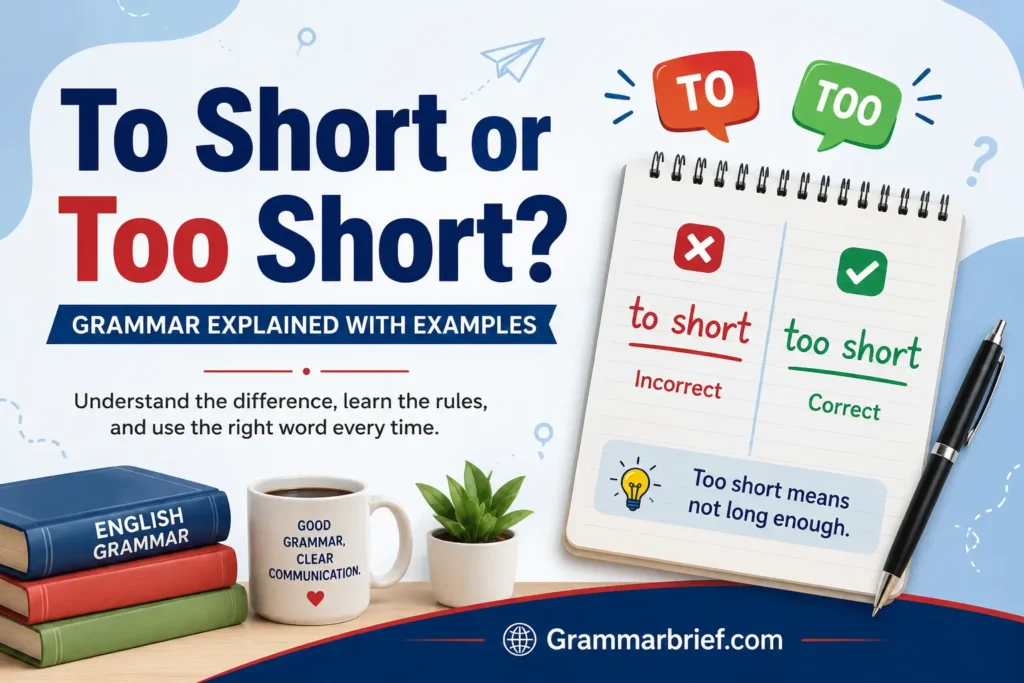

The phrase To Short or Too Short? Grammar Explained With Examples highlights a common grammar confusion in English. When you’re writing and wondering which words to use, remember this simple difference: too short means not long enough, while to short is incorrect when describing length.
This small error can affect your writing, clarity, and accuracy. The key grammar rule is easy to understand. Too is an adverb and modifier that works with adjectives to show excess. For example, “The sleeves are too short.” To usually works as a preposition showing direction or as an infinitive marker before an action.Understanding this grammatical distinction improves your English writing and language accuracy.
Because to and too sound alike, spelling mistakes can happen easily. Careful proofreading and editing can help you avoid this common mistake. Always check the context, meaning, and word usage before choosing the correct form. This approach helps you write clearly and correctly and build stronger English skills.
Is It “To Short” or “Too Short”?
The correct choice depends on what you mean, but when you’re describing something as excessively short, use “too short.”
Correct: The sleeves are too short.
Incorrect: The sleeves are to short.
Here, “too” tells you that the sleeves don’t reach the desired length. The sentence isn’t merely saying that the sleeves are short. It suggests that their shortness creates a problem.
Consider these examples:
- The cable is too short to reach the outlet.
- My haircut is too short for the style I wanted.
- The movie was too short to develop the story properly.
- These pants are too short for me.
- The answer is too short to explain the issue clearly.
A useful rule is simple:
Use “too” when you mean “more than acceptable, necessary, or suitable.”
That rule works with many other adjectives as well. You can say too long, too small, too expensive, too loud, too difficult, and too heavy.
So, if “too short” means “shorter than it should be,” the spelling becomes straightforward.
Read this also: Cacoon or Cocoon: Which Spelling Is Correct?
What’s the Difference Between “To” and “Too”?
The confusion starts because “to” and “too” are homophones in standard English. They sound the same, but they don’t perform the same grammatical job.
When to Use “To”
“To” has several important uses in English.
First, it can function as a preposition showing movement, direction, connection, or a relationship.
Examples include:
- We drove to the airport.
- Give the letter to James.
- She walked to the door.
- He moved to California.
Second, “to” can introduce an infinitive verb.
Examples:
- I want to learn.
- She needs to study.
- They decided to leave.
- We plan to travel.
Notice the pattern. In these examples, “to” connects with a noun, pronoun, place, or verb. It doesn’t modify an adjective such as short.
When to Use “Too”
“Too” commonly has two meanings.
The first means “more than necessary,” “more than desirable,” or “excessively.”
- The coffee is too hot.
- The box is too heavy.
- The road is too narrow.
- The skirt is too short.
The second meaning is “also” or “as well.”
- I want dessert too.
- She likes coffee too.
- You can come too.
That gives you a handy distinction:
| Word | Main function | Example | Meaning |
| to | Preposition | I went to work. | Direction or relationship |
| to | Infinitive marker | I want to sleep. | Introduces a verb |
| too | Adverb | It’s too short. | Excessive degree |
| too | Adverb | I want one too. | Also |
| two | Number | I bought two shirts. | The number 2 |
Once you recognize the function, the spelling becomes much easier.
What Does “Too Short” Mean?
The phrase “too short” means that something is shorter than a particular standard, requirement, expectation, or desired level.
That standard doesn’t always need to be stated. Context often supplies it.
For example:
“The rope is too short.”
The sentence doesn’t tell you the exact measurement. Still, you understand that the rope doesn’t reach where it needs to go.
Similarly:
“The presentation was too short.”
This usually means the presentation didn’t last long enough to cover the necessary material or meet expectations.
The phrase can describe physical length, height, distance, time, duration, writing, or other forms of extent.
“Too Short” for Physical Length
Physical objects often provide the clearest examples.
- The dress is too short.
- The table is too short for the equipment.
- The cable is too short.
- The curtain is too short for the window.
- The ladder is too short to reach the roof.
In each sentence, “too” signals a mismatch between the actual measurement and what’s needed.
“Too Short” for Time or Duration
You can also use “too short” when talking about time.
- The vacation was too short.
- The break was too short.
- The meeting was too short to cover every issue.
- The deadline was too short for the project.
- The film felt too short.
Here, short refers to duration rather than physical dimensions.
“Too Short” for Writing or Explanations
The same structure works with communication.
- Your answer is too short.
- The explanation was too short to be useful.
- The report is too short for the assignment.
- His response was too short to address the question.
This usage is particularly important because “short” doesn’t always refer to measurement. It can describe how much information, detail, or time something contains.
Why Is “To Short” a Common Mistake?
The biggest reason is sound.
In standard American English, “to” and “too” are pronounced alike. When you hear someone say a sentence such as “The sleeves are too short,” there’s no audible extra sound that tells you which spelling belongs on the page.
That makes this a classic homophone problem.
Homophones are words that share the same pronunciation but have different meanings, spellings, or grammatical functions. English has many of them:
- to / too / two
- there / their / they’re
- your / you’re
- right / write
- hear / here
The brain often identifies a familiar sound before it retrieves the correct spelling. That’s why people can know what a sentence means and still type the wrong word.
Fast texting can make the problem worse. If you write based entirely on sound, “to short” can slip onto the screen before you notice it.
Why Spell-Check Doesn’t Always Catch It
Grammar software and spell-checkers often recognize “to” as a correctly spelled English word.
That’s the catch.
In a sentence such as “The sleeves are to short,” the individual words aren’t misspelled. The problem lies in word choice and grammatical function.
A basic spell-checker may therefore miss the error. Context-aware grammar tools can sometimes identify it, but understanding the rule yourself remains more reliable.
Why “Too” Works in “Too Short”
In “too short,” the word “too” is an adverb modifying the adjective “short.”
Think of the sentence as a simple grammatical structure:
too + adjective
Examples:
- too short
- too tall
- too cold
- too expensive
- too complicated
- too narrow
- too slow
The adjective tells you what quality you’re describing. The adverb tells you the degree of that quality.
Compare these sentences:
The jacket is short.
This simply describes the jacket.
The jacket is very short.
This emphasizes the degree of shortness.
The jacket is too short.
This says the shortness exceeds what is acceptable or suitable in the situation.
That final distinction matters. “Very” describes intensity, while “too” often introduces a negative or limiting judgment.
“Too Short” vs. “Short Enough”
These expressions look different, but they often describe the same practical problem from opposite directions.
“Too short” emphasizes the problem.
“Not long enough” emphasizes the missing amount.
For example:
- The rope is too short.
- The rope isn’t long enough.
Both can mean that the rope cannot reach the intended point.
However, the two constructions aren’t always interchangeable in tone. “Too short” directly highlights the excessive degree of shortness. “Not long enough” focuses on the failure to meet a required length.
Consider this comparison:
| Expression | Main focus |
| The dress is short. | Neutral description |
| The dress is very short. | Strong degree of shortness |
| The dress is too short. | Shorter than suitable |
| The dress isn’t long enough. | Insufficient length |
This distinction helps you choose more precise language.
Real-Life Examples of “Too Short”
The phrase appears naturally in many everyday situations.
| Situation | Example |
| Clothing | These jeans are too short. |
| Hair | My hair is too short for a ponytail. |
| Cable | This cable is too short to reach the outlet. |
| Ladder | The ladder is too short to reach the roof. |
| Meeting | The meeting was too short to discuss everything. |
| Vacation | Our vacation was too short. |
| Essay | The essay is too short for the assignment. |
| Explanation | His explanation was too short to answer the question. |
| Distance | The runway is too short for that aircraft. |
| Break | The lunch break was too short. |
The underlying idea stays consistent: the available length or duration doesn’t meet the relevant need.
Common Mistakes With “To Short” and “Too Short”
❌ “This dress is to short.”
The problem is “to.” You’re describing the dress as shorter than appropriate.
✅ “This dress is too short.”
Here, “too” correctly modifies short.
❌ “The meeting was to short.”
You’re describing duration, so “too” is required.
✅ “The meeting was too short.”
The sentence says the meeting didn’t last as long as necessary.
❌ “My answer is to short.”
Again, “to” doesn’t modify short.
✅ “My answer is too short.”
This means the answer lacks the necessary length or detail.
❌ “The cable is to short to reach the outlet.”
✅ “The cable is too short to reach the outlet.”
This example also shows an important pattern:
too + adjective + to + verb
For instance:
- too short to reach
- too heavy to lift
- too difficult to understand
- too expensive to buy
The first “too” and the later “to” have completely different jobs.
Can “To Short” Ever Be Correct?
There is an important exception worth knowing.
Although “to short” is incorrect when you’re trying to describe something as insufficiently long, the words can appear together when “short” functions as a verb.
For example:
The investor decided to short the stock.
In financial language, short can function as a verb meaning to sell short or take a short position.
Here, “to” introduces the verb short. It isn’t modifying an adjective.
That’s fundamentally different from:
The sleeves are too short.
In that sentence, short is an adjective and too modifies it.
So the claim that “to short” can never appear under any circumstances would be too broad. The accurate rule is this:
Use “too short” when “short” is an adjective describing insufficient or excessive shortness.
This small distinction makes the grammar explanation much more precise.
“Too Short” vs. Similar Expressions
Understanding related phrases can make the main rule stick.
Too Short vs. Very Short
“Very short” simply emphasizes the degree of shortness.
The skirt is very short.
This doesn’t necessarily say the skirt is inappropriate or unsuitable.
“Too short” goes further.
The skirt is too short for the event.
Now the length fails a particular expectation.
Too Short vs. Extremely Short
“Extremely short” describes an unusually high degree of shortness.
The speech was extremely short.
It doesn’t automatically say the speech was inadequate.
“Too short” usually introduces an implied standard.
The speech was too short to explain the proposal.
The second sentence tells you why the length was a problem.
Read this also: HY Meaning: What Does HY Mean in Text?
Too Short vs. Not Long Enough
These often overlap:
The cable is too short.
The cable isn’t long enough.
Both indicate insufficient length. The first uses “too” to frame the problem as excessive shortness. The second frames it as insufficient length.
To, Too, and Two: A Quick Memory Guide
The third word in this group, “two,” adds another layer of confusion because it also sounds the same.
The easiest way to separate them is by meaning.
To = direction, connection, or infinitive
Think:
- go to school
- talk to her
- want to eat
Too = excess or addition
Think:
- too short
- too expensive
- me too
Two = the number 2
Think:
- two books
- two hours
- two people
A quick mental test can help.
If you can replace the word with “also,” you probably need “too.”
I want to come too.
I want to come also.
If you can replace the idea with “more than necessary,” you also need “too.”
The rope is too short.
The rope is shorter than necessary.
If you’re talking about movement or an infinitive, “to” is usually the right choice.
We went to the store.
I want to leave.
And if you’re counting, use “two.”
I bought two shirts.
A Simple Test for Choosing “Too”
When you’re unsure whether to write “to short” or “too short,” don’t rely on pronunciation. Test the meaning instead.
Ask yourself:
Am I saying that something is shorter than necessary or desirable?
If yes, use “too short.”
For example:
The sleeves are ___ short.
Are the sleeves shorter than they should be?
Yes → too short.
Try the same method with other adjectives:
- ___ expensive → too expensive
- ___ loud → too loud
- ___ small → too small
- ___ long → too long
- ___ difficult → too difficult
The pattern becomes almost automatic once you recognize it.
Case Study: Why Context Changes the Meaning
Imagine someone buys a pair of jeans online.
When the jeans arrive, they say:
“These jeans are short.”
That’s a neutral description. The jeans have a short length.
Now suppose the jeans stop several inches above the buyer’s ankles.
“These jeans are too short.”
The meaning has changed. The speaker now compares the actual length with a desired or expected length.
The same distinction works with time.
“The meeting was short.”
This simply tells you that the meeting didn’t last very long.
“The meeting was too short.”
Now the speaker suggests that the meeting lacked enough time to accomplish something.
This is why “too” is more than an intensifier. It often introduces an evaluation against an implied standard.
Practice: Choose “To,” “Too,” or “Two”
Try these sentences before checking the answers.
- This shirt is ___ short for me.
- I need ___ buy a new one.
- She bought ___ pairs of shoes.
- The movie was ___ short.
- Are you coming ___?
- We drove ___ the store.
- The explanation was ___ short to be useful.
- I want ___ go home.
Answers
- too
- to
- two
- too
- too
- to
- too
- to
The key isn’t memorizing isolated sentences. It’s recognizing the grammatical role each word plays.
Frequently Asked Questions About “To Short or Too Short”
Q1: Is “too short” grammatically correct?
Yes. “Too short” is grammatically correct when something doesn’t have enough length, height, or duration for a particular purpose.
Q2: Is “to short” ever correct?
Yes, but not when describing insufficient length. “To short” can appear when short functions as a verb, such as in certain financial contexts.
Q3: What does “too short” mean?
“Too short” means something is shorter than needed, expected, suitable, or desired.
Q4: Is “too” an adverb in “too short”?
Yes. “Too” is an adverb that modifies the adjective “short.”
Q5: Why do people confuse “to” and “too”?
They often confuse them because “to” and “too” sound the same in normal speech. Their meanings and grammatical functions differ.
Q6: Which is correct: “to long” or “too long”?
“Too long” is correct when something exceeds the desired or acceptable length or duration.
Q7: Is it “way too short” or “way to short”?
“Way too short” is correct. The word “way” intensifies the phrase in informal English.
Q8: What is another way to say “too short”?
Depending on the context, you can use “not long enough,” “insufficient,” “inadequate,” or “brief.”
Q9: How can I remember “to” and “too”?
Remember that “too” can mean “excessively” or “also.” “To” commonly shows direction or introduces an infinitive.
Q10: What is the difference between “to,” “too,” and “two”?
“To” commonly shows direction or introduces a verb, “too” means excessively or also, and “two” refers to the number 2.
Conclusion
Choosing between “to short” and “too short” becomes easy once you understand their grammatical roles. Use “too short” when something isn’t long enough or exceeds an acceptable limit. Here, “too” acts as an adverb that modifies the adjective “short.” On the other hand, “to” usually shows direction or introduces an infinitive verb. Since both words sound alike, they can cause spelling mistakes in everyday English writing. The easiest way to remember the rule is to connect “too” with excess. When you mean that something lacks the needed length, “too short” is the correct choice.