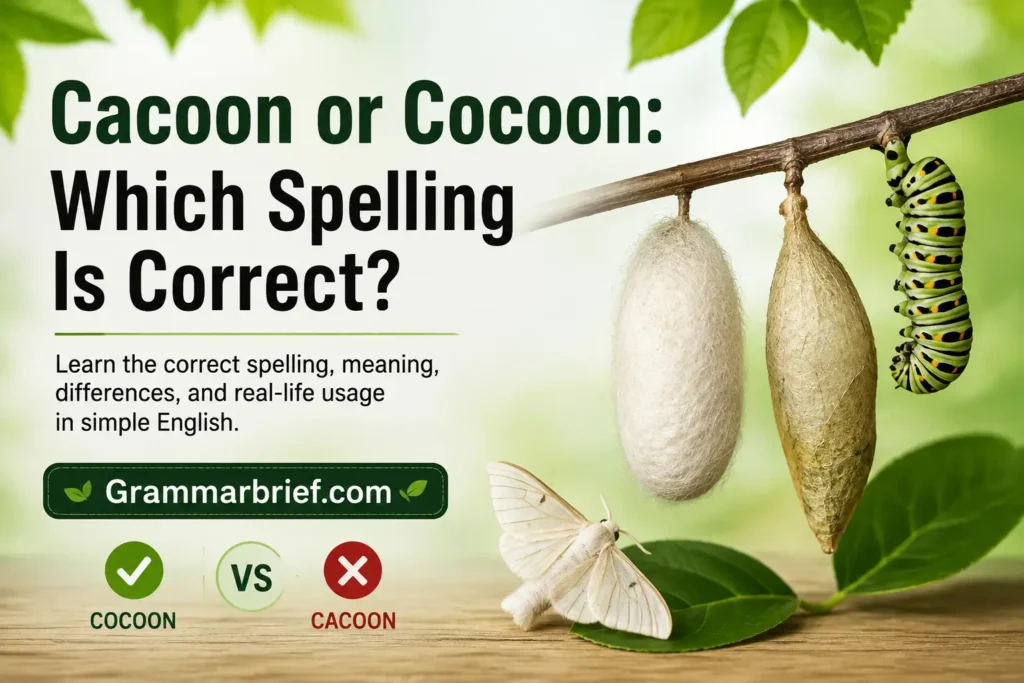

If you’re wondering Cacoon or Cocoon: Which Spelling Is Correct?, the correct spelling for the insect-related word is cocoon. People, English learners, writers, students, and native speakers may confuse these words because of their similar sound, similar spelling, and spoken language. In standard English, cacoon is a common misspelling when referring to an insect covering.
A cocoon is a protective shelter, protective covering, or protective structure used by certain insects, including some caterpillars, silkworms, and moths, during metamorphosis. It provides safety, comfort, and protection in nature.However, cacoon can be a real word in a different context. It can refer to a tropical bean connected with the tropical plant Fevillea cordifolia, especially in botanical studies and craft works.
Therefore, cacoon vs cocoon depends on meaning and usage. For better writing accuracy, spelling accuracy, and English writing, use practical strategies for remembering the correct word. Reading real-world examples can help you understand the meaning, read easily, and choose the right word with confidence.
Quick Answer: Cacoon or Cocoon?
Cocoon is the correct spelling for the familiar insect structure.
A cocoon is generally a protective covering produced by certain insect larvae, often from silk or other fibrous material, around the pupal stage. Moths are especially well known for making cocoons.
Cacoon, meanwhile, isn’t the standard spelling of that insect-related word. If you write cacoon when you mean the insect covering, you’ve almost certainly made a spelling mistake.
There is one important exception. Cacoon is an established dictionary word for certain tropical plants or beans. Merriam-Webster lists it in connection with the snuffbox bean and Fevillea cordifolia, while Collins records a large bean associated with Entada scandens.
Read this also: Ways to Say “I Can’t Wait to See What the Future Holds”: 30 Natural Alternatives
At a glance
| Word | Correct? | Main meaning |
| Cocoon | Yes | Protective covering made by certain insects |
| Cacoon | Yes, in a specific context | A tropical plant or bean |
| Cacoon for an insect covering | No | Usually a misspelling of cocoon |
That distinction clears up most of the confusion immediately.
What Does “Cocoon” Mean?
The word cocoon has both a literal biological meaning and several figurative meanings.
In biology, a cocoon is a protective case that some insect larvae construct around themselves before or during the pupal stage. The structure can protect the developing insect while it undergoes major physical changes.
The classic example is a moth caterpillar spinning silk around itself.
Yet not every insect that undergoes complete metamorphosis builds a cocoon. That’s an important distinction because people often use cocoon, pupa, and chrysalis as though they’re interchangeable.
They aren’t.
Cocoon as a Noun
As a noun, cocoon commonly describes the protective structure surrounding a developing insect.
For example:
- The moth emerged from its cocoon.
- The caterpillar spun a silk cocoon.
- The researcher carefully examined the cocoon.
- Several cocoons hung from the branches.
The plural form is cocoons, not cocoones or cacoons.
A cocoon can also describe a similar protective covering in nature. Dictionaries include broader uses for protective structures that resemble the insect structure.
Cocoon as a Verb
Cocoon also works as a verb.
To cocoon something means to wrap, surround, protect, or isolate it as though it were inside a cocoon. The verb can describe both literal coverings and figurative protection.
For example:
- She cocooned herself in a warm blanket.
- The thick insulation cocooned the building.
- He cocooned himself away from the noise outside.
The word can therefore describe an action rather than an object.
Cocoon in Everyday and Figurative Language
Modern English uses cocoon far beyond entomology.
A person might describe their home as a cocoon when it feels peaceful, private, and protected from the outside world. Cambridge specifically recognizes this figurative idea of a cocoon as a safe, quiet place.
You might see phrases such as:
- “a cocoon of warmth”
- “a cocoon of comfort”
- “a cocoon of silence”
- “a protective cocoon”
- “living in a cocoon”
The metaphor works because the original biological image is so vivid: something enclosed, sheltered, and temporarily separated from its surroundings.
Is “Cacoon” a Real Word?
Here’s where a simple spelling guide can become misleading.
Cacoon is a real English word, but it doesn’t normally mean an insect’s cocoon.
Merriam-Webster defines cacoon as a West Indian snuffbox bean and also identifies it with a tropical American plant, Fevillea cordifolia. Collins gives another botanical sense associated with the large bean of Entada scandens.
That means you shouldn’t automatically “correct” every occurrence of cacoon to cocoon.
Context matters.
For instance:
The moth formed a cocoon.
Here, cocoon is correct.
But:
The book describes the cacoon bean.
Here, cacoon can be correct if the writer is using the botanical term.
This distinction also explains why simply saying “cacoon isn’t a word” isn’t completely accurate.
A better statement is:
“Cacoon is not the standard spelling for the insect structure called a cocoon.”
Cacoon vs. Cocoon: Side-by-Side Comparison
The two words differ by only one letter, yet their meanings can be completely different.
| Feature | Cocoon | Cacoon |
| Standard spelling for an insect covering | Yes | No |
| Refers to certain moths’ protective coverings | Yes | No |
| Can be used figuratively | Yes | Not in this standard sense |
| Can function as a verb | Yes | Not in the same sense |
| Botanical meaning | No | Yes |
| Common spelling error | No | Yes, when intended to mean cocoon |
| Correct for general insect-related writing | Yes | No |
The key isn’t merely the letter difference. It’s the meaning behind the word.
Why Do People Confuse “Cacoon” and “Cocoon”?
The confusion is understandable because the two spellings look almost identical.
Similar Pronunciation
Both words contain the same basic -coon ending, which makes the written distinction easy to overlook.
Cocoon is pronounced approximately /kəˈkuːn/ in English. The stress falls on the second syllable.
Because English spelling doesn’t always follow pronunciation perfectly, hearing the word doesn’t necessarily tell you whether the first vowel should be o or a.
Spelling by Sound
When people write unfamiliar words from memory, they often choose letters that seem to match what they hear.
That’s one reason cacoon can appear when someone means cocoon. The pronunciation doesn’t provide a strong visual clue for the first vowel.
It’s a classic case of phonetic guessing.
The Word’s Unusual Visual Pattern
Cocoon contains three consecutive vowel sounds represented through repeated o letters:
C-O-C-O-O-N
That pattern can look unusual if you’ve never consciously noticed it before.
Once you’ve seen the correct spelling several times, however, it becomes much easier to recognize.
Fast Typing and Autocorrect
Digital writing adds another layer.
People often type quickly, rely on memory, or accept the first suggestion that looks familiar. A one-letter substitution can slip into a message without attracting much attention.
That’s particularly true when both cacoon and cocoon look plausible at a glance.
How to Spell “Cocoon” Correctly
The correct spelling is:
C-O-C-O-O-N
A useful way to remember it is to focus on the repeated co pattern followed by on:
CO + CO + ON = COCOON
Another trick is to picture the word itself as enclosed around the middle oo. It isn’t a linguistic rule, of course, but visual associations can make spelling easier to retrieve.
If you’re writing about insects, silk, moths, metamorphosis, or pupae, cocoon should be your default spelling.
How to Use “Cocoon” in a Sentence
Seeing the word in context makes the distinction much easier to remember.
Biological Examples
- The moth remained inside its cocoon while developing.
- The caterpillar spun a protective cocoon from silk.
- Researchers collected the cocoons for further study.
- A small cocoon was attached to the underside of a leaf.
These examples use cocoon in its literal biological sense.
Everyday Examples
The word can also describe a protective environment.
- She created a cozy cocoon of blankets on the sofa.
- The quiet bedroom became his weekend cocoon.
- Thick curtains gave the room a warm, private cocoon.
Here, no insect is involved. The writer uses the physical idea of enclosure as a metaphor for comfort and protection.
Figurative Examples
- The family provided a cocoon of support during a difficult period.
- The small community became a cocoon of familiarity.
- He stayed inside his comfortable cocoon for several weeks.
These examples show why cocoon has become such a flexible word in modern English.
Cocoon vs. Chrysalis vs. Pupa: What’s the Difference?
This is one of the most important factual distinctions surrounding the word.
A pupa is a developmental stage in insects that undergo complete metamorphosis.
A cocoon is a protective covering that some insects construct around the pupa.
A chrysalis is the pupal case of a butterfly.
In other words, these terms describe related but different things.
| Term | Meaning |
| Pupa | A developmental life stage between larva and adult |
| Cocoon | A protective covering produced by some insects around the pupa |
| Chrysalis | The pupal case of a butterfly |
This is why calling every butterfly’s pupal case a “cocoon” isn’t biologically precise.
Do Butterflies Make Cocoons?
Generally, butterflies don’t make cocoons.
Instead, a butterfly caterpillar forms a chrysalis, which is its pupal stage and protective case. Moths are much more commonly associated with silk cocoons. (Butterfly House)
The distinction becomes clearer when you separate the pupa itself from a covering around the pupa.
A moth may spin silk around its pupa. A butterfly typically forms a hardened chrysalis without constructing a separate silk cocoon.
So, in precise biological writing:
- Moth → may make a cocoon
- Butterfly → forms a chrysalis
- Both → undergo a pupal stage
There are many variations across insect groups, so the safest approach is to identify the actual structure rather than assuming every pupa has a cocoon.
What Is a Cocoon Made Of?
Many familiar cocoons consist largely of silk produced by the insect.
The silkworm is the famous example. Its cocoon consists of a continuous silk filament produced by the larva. Silk production has therefore made the cocoon important not only in biology but also in human history and textile manufacturing.
However, nature isn’t a one-pattern system.
Different insects can construct protective coverings using different materials or combinations of materials. Some incorporate plant fragments, soil, or other environmental material into their shelters.
The basic principle remains the same: the structure provides protection around a vulnerable developmental stage.
What Is the Purpose of a Cocoon?
A cocoon serves as a protective structure during a particularly vulnerable period.
Protection During Development
The developing insect cannot simply behave like an active adult. A protective covering can help shield it from environmental hazards and physical disturbance.
A Sheltered Space for Metamorphosis
Inside the protected environment, the insect undergoes dramatic developmental changes.
The transformation from larva to adult isn’t a minor adjustment. The body reorganizes extensively as the adult form develops.
Different Insects Use Different Strategies
Not every species needs the same type of protection.
Some insects construct elaborate cocoons. Others rely on a pupa’s own hardened outer covering or use different protective strategies.
That’s why cocoon should describe the actual structure rather than simply becoming a generic synonym for pupa.
Where Does the Word “Cocoon” Come From?
The spelling of cocoon has a long linguistic history.
Merriam-Webster traces the noun through French cocon to Occitan coucoun, connected with a word meaning “shell.” It records the English noun from the late 17th century, with the verb appearing later.
Oxford gives a similar history, tracing cocoon through French and medieval Provençal forms associated with a shell or eggshell.
This history helps explain why the spelling isn’t simply something English speakers invented from the modern pronunciation.
The word entered English as a borrowed term and retained its distinctive co-coon spelling.
Read this also: 50 Be There or Be Square Alternatives for Any Occasion
What Is the “Cacoon Bean”?
The word cacoon has a separate botanical history.
Merriam-Webster identifies cacoon with a tropical American plant and a West Indian snuffbox bean. Collins also records cacoon for a large bean associated with Entada scandens.
So if you’re reading botanical, historical, or ethnobotanical material, you may legitimately encounter cacoon.
This creates an important language lesson:
Two words can look almost identical while referring to completely different things.
The insect covering is cocoon.
The botanical term can be cacoon.
That isn’t a spelling variation of the same word. It’s a distinction between separate lexical items.
Common Mistakes With “Cacoon” and “Cocoon”
Writing “Cacoon” for an Insect Covering
Incorrect:
The caterpillar built a cacoon.
Correct:
The caterpillar built a cocoon.
If you’re discussing moths, silk, pupae, or insect metamorphosis, cocoon is the spelling you want.
Assuming “Cacoon” Is Always Wrong
This is the opposite mistake.
Because cacoon often appears as a misspelling, some writers assume it can never be legitimate. That’s too broad.
The botanical word cacoon does exist.
Confusing Cocoon With Chrysalis
A butterfly’s chrysalis isn’t simply another name for every cocoon.
Use chrysalis when you specifically mean the butterfly’s pupal case.
Assuming Every Pupa Has a Cocoon
A pupa is a developmental stage.
A cocoon is a protective structure made by some insects.
Keeping those definitions separate prevents a surprisingly common biology mistake.
Does American or British English Change the Spelling?
No major US-versus-UK spelling difference changes cocoon to cacoon.
Both American and British English use cocoon for the familiar insect covering. Dictionary sources also show essentially the same pronunciation and core biological meaning across the two varieties.
So this isn’t a case like color versus colour.
If you mean the insect structure, cocoon is the safe standard spelling in both varieties of English.
How to Remember “Cocoon” Instead of “Cacoon”
A simple memory trick can save you from the mistake.
Remember the Double “O”
Focus on the oo near the end:
COCOON
That double o is one of the word’s most recognizable features.
Think “CO + CO + ON”
Break the spelling visually:
CO | CO | ON
This makes the repeated o pattern easier to remember.
Connect the Word With Its Meaning
Imagine the rounded shape of a cocoon enclosing the developing insect.
Then picture the word enclosing its own repeated o sounds:
COCOON
It’s a small visual trick, but it gives the spelling something memorable to hang onto.
Quick Reference: Cacoon or Cocoon?
Here’s the entire distinction in a few lines:
- Cocoon is the standard spelling for the protective covering made by certain insects.
- Cacoon is usually incorrect when someone intends to write cocoon.
- Cacoon can be a legitimate botanical term for certain tropical plants or beans.
- Pupa refers to an insect’s developmental stage.
- Chrysalis refers specifically to the pupal case of a butterfly.
- Cocoon can also work as a verb.
- Cocoon has several established figurative meanings involving protection, comfort, and isolation.
Frequently Asked Questions About Cacoon or Cocoon
Q1. Which spelling is correct, cacoon or cocoon?
Cocoon is the correct spelling when you mean the protective covering associated with certain insects. Cacoon has a different botanical meaning.
Q2. Is cacoon a real English word?
Yes. Cacoon is a real word in a specific botanical context. It can refer to a tropical bean or plant, so it isn’t always simply an incorrect word.
Q3. What does cocoon mean?
A cocoon is a protective covering made by certain insects, especially some moths, during their development and metamorphosis.
Q4. Why do people spell cocoon as cacoon?
People may confuse the spellings because of their similar sound and the way cocoon is pronounced in spoken English. Fast typing can also cause spelling mistakes.
Q5. Do caterpillars make cocoons?
Some caterpillars, especially moth caterpillars, make cocoons before becoming adults. However, not every caterpillar creates a cocoon.
Q6. What is the difference between cocoon and chrysalis?
A cocoon is a protective covering usually made from silk or other material. A chrysalis is the pupal stage or case of a butterfly.
Q7. How can I remember the spelling of cocoon?
A simple trick is to remember the double “oo” in cocoon. Connecting the spelling with insects and their protective covering can also make it easier to remember.
Conclusion
The correct spelling for the insect-related term is cocoon, not cacoon. A cocoon is a protective covering made by certain insects during metamorphosis. Although cacoon is usually a misspelling in this context, it can be a legitimate word when referring to a tropical bean or related plant. Remembering this difference makes your English writing, spelling accuracy, and word usage clearer. When you see cacoon or cocoon, check the meaning and context before choosing the spelling.