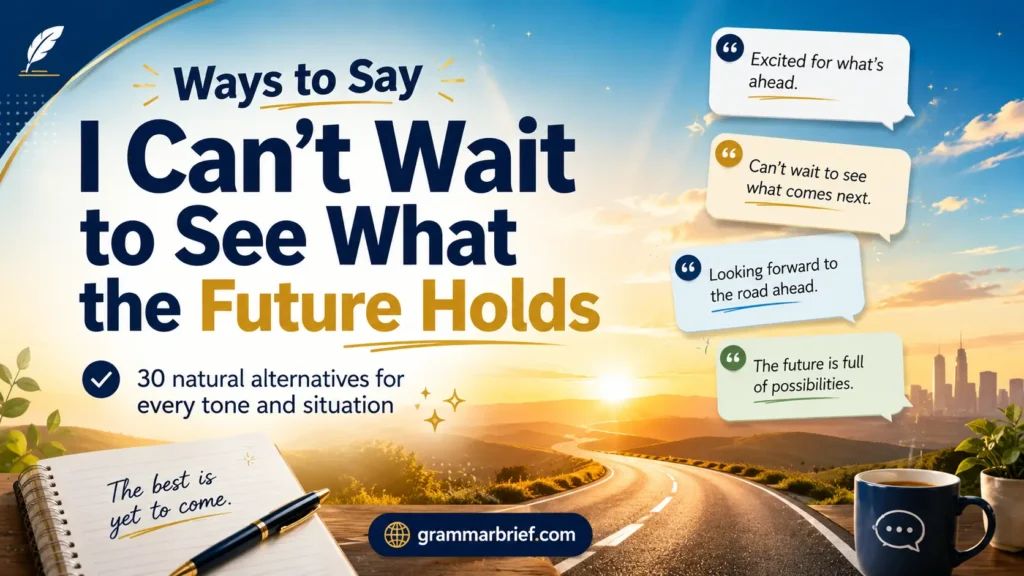

Future holds alternatives help you express hope, curiosity, excitement, and optimism about what is next without repeating the same phrase. The common phrase “I can’t wait to see what the future holds” shows a genuine belief that good things may be coming. When you’re looking ahead, the unknown can feel exciting, especially during a big change. You may not know where the road leads, but you feel ready to face new possibilities with confidence and faith.
People often say I can’t wait to see what the future holds during major life events such as graduations, new jobs, and fresh starts. These moments can bring new opportunities, new chances, and unexpected surprises. Instead of waiting passively, the expression shows that you’re motivated to keep trying, continue learning, and shape your own future.
However, the right words matter. A familiar sentence may sometimes feel repetitive or less personal. Using fresh options such as “I’m excited about what comes next” keeps the same deep meaning while making your message sound natural, positive, and genuine.
What Does “I Can’t Wait to See What the Future Holds” Mean?
The phrase means you feel excited, hopeful, or curious about future events.
When someone says it, they aren’t claiming to know what will happen. Instead, they’re expressing anticipation about new possibilities.
For example:
“This new job feels like a fresh start. I can’t wait to see what the future holds.”
Here, the speaker feels optimistic about an uncertain future.
The phrase can communicate several emotions:
- Excitement about upcoming experiences
- Hope for positive changes
- Curiosity about unknown possibilities
- Confidence in future progress
- Anticipation about a new stage of life
In simple terms, it means:
“I’m excited to see what happens next.”
Read this also: 50 Be There or Be Square Alternatives for Any Occasion
When to Say “I Can’t Wait to See What the Future Holds”
This expression works best when something new is beginning.
For instance, people often use it after:
- starting a new job
- graduating
- beginning a relationship
- moving to a new city
- launching a business
- completing a major project
- getting engaged or married
- reaching an important milestone
Imagine someone finishing college. They may write:
“Four unforgettable years are behind me. I can’t wait to see what the future holds.”
Likewise, a business owner might say:
“We’ve grown so much this year. I’m excited to see what comes next.”
Both messages express optimism, although the second sounds slightly more direct.
Is “I Can’t Wait to See What the Future Holds” Professional?
Yes, you can use it professionally. However, the setting matters.
The phrase sounds friendly and optimistic, which makes it suitable for:
- farewell emails
- career announcements
- LinkedIn posts
- project celebrations
- retirement messages
- team updates
For example:
“It has been a privilege working with this team. I can’t wait to see what the future holds.”
Still, in a formal business message, a calmer alternative may sound more polished.
Try:
“I’m looking forward to what lies ahead.”
or:
“I’m excited about the opportunities ahead.”
These options preserve the optimism without sounding overly emotional.
30 Other Ways to Say “I Can’t Wait to See What the Future Holds”
Different situations call for different tones. The alternatives below range from professional to casual, hopeful, and personal.
Professional and Polished Alternatives
I’m Looking Forward to What Lies Ahead
This is one of the safest professional alternatives. It sounds optimistic without becoming too emotional.
Use it in:
- work emails
- career updates
- farewell messages
- business announcements
Example:
“I’m grateful for everything I’ve learned here, and I’m looking forward to what lies ahead.”
I’m Excited to See What Comes Next
This phrase sounds energetic but still natural.
It works well when you want to show enthusiasm about a project, career move, or personal milestone.
Example:
“This project has opened new doors, and I’m excited to see what comes next.”
I Look Forward to What the Future Brings
This version sounds slightly more formal.
Because it uses “I look forward” instead of “I’m looking forward,” it fits professional writing especially well.
Example:
“Thank you for your continued support. I look forward to what the future brings.”
I’m Eager to See Where This Leads
Use this when something has already started, but you don’t yet know the outcome.
Example:
“Our partnership has begun on a strong note. I’m eager to see where this leads.”
I’m Optimistic About What Lies Ahead
This phrase focuses on confidence rather than excitement.
Example:
“Despite the challenges we’ve faced, I’m optimistic about what lies ahead.”
I’m Looking Forward to the Opportunities Ahead
This choice works particularly well in career or business settings.
Example:
“I’m proud of the progress we’ve made and looking forward to the opportunities ahead.”
I’m Excited About What We Can Achieve Next
Use this when talking about shared goals.
Example:
“We accomplished a lot this quarter. I’m excited about what we can achieve next.”
I’m Looking Forward to the Next Chapter
This phrase suits career changes, graduation, retirement, or any major transition.
Example:
“After ten rewarding years with the company, I’m looking forward to the next chapter.”
Casual Ways to Say “I Can’t Wait to See What the Future Holds”
I Can’t Wait to See What’s Next
Short, friendly, and direct.
“This year has already been amazing. I can’t wait to see what’s next.”
I’m Ready for Whatever Comes Next
This sounds confident and adventurous.
“One chapter is ending, but I’m ready for whatever comes next.”
Let’s See Where This Takes Us
This phrase feels relaxed and curious.
“We’ve started something exciting. Let’s see where this takes us.”
I’m Excited for What’s Around the Corner
This expression adds a playful sense of mystery.
“Big changes are coming, and I’m excited for what’s around the corner.”
Here’s to Whatever Comes Next
Perfect for captions, celebrations, or farewell posts.
“Here’s to new beginnings and whatever comes next.”
I’m Curious to See How Things Turn Out
Use this when curiosity matters more than excitement.
“We’ve taken the first step. Now I’m curious to see how things turn out.”
I Can’t Wait to See How It All Unfolds
This sounds slightly more expressive.
“There are so many moving pieces right now. I can’t wait to see how it all unfolds.”
Positive and Inspirational Alternatives
The Best Is Yet to Come
This classic phrase expresses strong optimism.
“We’ve achieved so much already, but the best is yet to come.”
The Future Looks Bright
Use this when you feel confident about upcoming opportunities.
“With such a talented team, the future looks bright.”
There’s So Much to Look Forward To
This sounds warm and encouraging.
“A new city, a new job, and new experiences—there’s so much to look forward to.”
Exciting Things Are Ahead
Simple language often carries the most energy.
“We’ve built a strong foundation. Exciting things are ahead.”
The Road Ahead Is Full of Possibility
This phrase uses a journey metaphor without sounding overly dramatic.
“The road ahead is full of possibility, and every step brings something new.”
The Future Is Full of Opportunities
Use this when you want a hopeful but practical tone.
“Change can feel uncertain, but the future is full of opportunities.”
A New Chapter Is Just Beginning
This expression works well for transitions.
“Graduation isn’t the end. A new chapter is just beginning.”
There’s Plenty to Be Excited About
This sounds grounded and positive.
“We still have work to do, but there’s plenty to be excited about.”
Personal and Relationship-Focused Alternatives
I’m Excited to See Where Life Takes Us
This phrase feels warm and intimate.
“We’ve already shared so much. I’m excited to see where life takes us.”
I’m Looking Forward to Our Future Together
This expression works well in romantic relationships.
“Every year with you feels special. I’m looking forward to our future together.”
I Can’t Wait to See What’s Ahead for Us
It sounds emotional without becoming overly formal.
“We’ve come a long way, and I can’t wait to see what’s ahead for us.”
I’m Excited for Everything We Have Ahead of Us
This version feels especially affectionate.
“There’s still so much for us to experience. I’m excited for everything we have ahead of us.”
Here’s to the Next Chapter Together
Use this for anniversaries, engagements, weddings, or shared milestones.
“Here’s to everything we’ve built and to the next chapter together.”
I’m Ready for Whatever Comes Our Way
This phrase communicates commitment.
“Life won’t always be predictable, but I’m ready for whatever comes our way.”
I Can’t Wait to Make More Memories Together
This is warmer and more personal than talking broadly about “the future.”
“We’ve had some unforgettable adventures. I can’t wait to make more memories together.”
Best Alternatives by Situation
Choosing the right phrase becomes easier when you match it to the context.
| Situation | Best Alternative | Tone |
| Professional email | I’m looking forward to what lies ahead. | Professional |
| Career announcement | I’m excited for the next chapter. | Optimistic |
| Graduation | The best is yet to come. | Inspirational |
| Romantic relationship | I’m looking forward to our future together. | Warm |
| Friendship | I can’t wait to see what’s next. | Casual |
| Business partnership | I’m eager to see where this leads. | Professional |
| Social media caption | Here’s to whatever comes next. | Friendly |
| Major life change | I’m ready for whatever comes next. | Confident |
How to Choose the Right Alternative
The best phrase isn’t always the most creative one. Instead, choose wording that matches your relationship, setting, and emotion.
Match the Phrase to Your Relationship
With a coworker, “I’m looking forward to what lies ahead” sounds polished.
With a close friend, “I can’t wait to see what’s next” feels more relaxed.
For a romantic partner, “I’m excited to see where life takes us” sounds more personal.
Consider the Level of Formality
Professional settings usually favor calm confidence.
For example:
“I’m optimistic about the opportunities ahead.”
Casual settings allow more emotion:
“I’m so excited for what’s next!”
Neither version is better in every situation. Context decides.
Match Your Words to the Situation
If you’re discussing a career, focus on opportunities, growth, or the next chapter.
For relationships, phrases about our future, memories, or what lies ahead for us sound more natural.
Keep Your Excitement Genuine
Overly dramatic language can weaken your message.
For example:
“The endless mysteries of tomorrow fill my soul with electrifying anticipation.”
Technically, it communicates excitement. In normal conversation, though, it sounds unnatural.
A simpler sentence works better:
“I’m excited to see what comes next.”
“Future Holds” vs. “What Lies Ahead”
Both expressions refer to future possibilities, yet their tone differs slightly.
“What the future holds” sounds more reflective. It emphasizes uncertainty.
“No one knows what the future holds.”
Meanwhile, “what lies ahead” often sounds smoother and more professional.
“I’m looking forward to what lies ahead.”
| Phrase | Tone | Best Use |
| What the future holds | Reflective, curious | Personal writing |
| What lies ahead | Polished, optimistic | Professional writing |
“I’m Excited for What’s Next” vs. “I’m Looking Forward to What’s Next”
Both expressions communicate anticipation.
However, “I’m excited” carries stronger energy.
“I’m excited for what’s next!”
By contrast, “I’m looking forward to” sounds calmer.
“I’m looking forward to what’s next.”
Use the first in casual announcements or social posts. Choose the second when you want a more measured tone.
How to Use These Phrases in Professional Emails
Professional writing works best when excitement sounds sincere rather than exaggerated.
Starting a New Role
“I’m grateful for this opportunity and excited about what lies ahead.”
Finishing a Project
“We’ve achieved an important milestone, and I’m looking forward to what we can accomplish next.”
Leaving a Company
“I’m thankful for everything I’ve learned here and optimistic about the next chapter.”
Beginning a Partnership
“We’re excited to begin working together and eager to see where this partnership leads.”
Congratulating Someone
“Congratulations on this achievement. I’m excited to see what comes next for you.”
Mini Case Study: Choosing the Right Tone
Imagine Sarah is leaving a company after six years.
She first writes:
“I can’t wait to see what the future holds!”
The sentence isn’t wrong. Still, it sounds slightly casual for a formal farewell email.
She changes it to:
“I’m grateful for the experiences I’ve had here, and I’m looking forward to what lies ahead.”
The revised version keeps the optimism while sounding more professional.
That small adjustment shows why tone matters.
How to Use These Alternatives in Social Media Captions
Social media gives you more room to sound personal.
Career Announcement
“New role. New challenges. I’m excited to see what comes next.”
Graduation
“One chapter closes today. The best is yet to come.”
Relationship Milestone
“Another year together, and I’m still excited to see where life takes us.”
New Beginning
“Fresh start, clear goals, and plenty to look forward to.”
Personal Growth
“A lot has changed this year. Here’s to whatever comes next.”
Common Mistakes to Avoid
Using Too Much Emotion in Formal Writing
Words such as thrilled, ecstatic, or buzzing may feel excessive in conservative professional settings.
Instead, use:
- looking forward to
- optimistic about
- eager to see
- excited about
Repeating “Excited” Too Often
If every sentence starts with “I’m excited,” your message loses energy.
Try varying your vocabulary:
- eager
- hopeful
- optimistic
- curious
- looking forward to
- ready
Choosing a Phrase That Sounds Forced
Natural language usually wins.
“I’m looking forward to what’s next” often sounds better than a complicated phrase designed only to appear unique.
Confusing Anticipation With Prediction
Saying “I can’t wait to see what the future holds” doesn’t mean you know what’s coming.
Instead, the phrase acknowledges uncertainty while expressing hope.
Using “Looking Forward” Incorrectly
After looking forward to, use a noun, pronoun, or -ing form.
Correct:
“I’m looking forward to seeing what happens.”
Also correct:
“I’m looking forward to what lies ahead.”
Quick Reference: 30 Alternatives at a Glance
| Alternative | Best Tone |
| I’m looking forward to what lies ahead | Professional |
| I’m excited to see what comes next | Friendly |
| I look forward to what the future brings | Formal |
| I’m eager to see where this leads | Professional |
| I’m optimistic about what lies ahead | Confident |
| I’m looking forward to the opportunities ahead | Career-focused |
| I’m excited about what we can achieve next | Team-focused |
| I’m looking forward to the next chapter | Reflective |
| I can’t wait to see what’s next | Casual |
| I’m ready for whatever comes next | Confident |
| Let’s see where this takes us | Relaxed |
| I’m excited for what’s around the corner | Playful |
| Here’s to whatever comes next | Friendly |
| I’m curious to see how things turn out | Curious |
| I can’t wait to see how it all unfolds | Expressive |
| The best is yet to come | Inspirational |
| The future looks bright | Optimistic |
| There’s so much to look forward to | Warm |
| Exciting things are ahead | Positive |
| The road ahead is full of possibility | Inspirational |
| The future is full of opportunities | Hopeful |
| A new chapter is just beginning | Motivational |
| There’s plenty to be excited about | Natural |
| I’m excited to see where life takes us | Personal |
| I’m looking forward to our future together | Romantic |
| I can’t wait to see what’s ahead for us | Warm |
| I’m excited for everything we have ahead | Affectionate |
| Here’s to the next chapter together | Celebratory |
| I’m ready for whatever comes our way | Committed |
| I can’t wait to make more memories together | Personal |
Frequently Asked Questions
Q1: What does “I can’t wait to see what the future holds” mean?
It means you feel excited, hopeful, or curious about what may happen next in your life, career, relationship, or another situation.
Q2: What can I say instead of “I can’t wait to see what the future holds”?
You can say “I’m looking forward to what lies ahead,” “I’m excited to see what’s next,” or “The future looks bright.”
Q3: Is “I can’t wait to see what the future holds” correct English?
Yes. The phrase is natural and grammatically correct. People often use it when talking about new beginnings, opportunities, and important life changes.
Q4: Is this phrase professional?
Yes, although a more polished option may work better in formal writing. For example, try “I’m looking forward to what lies ahead.”
Q5: What is a professional alternative to “I can’t wait to see what happens next”?
Good professional options include “I’m eager to see where this leads” and “I’m looking forward to the opportunities ahead.”
Q6: What does “what the future holds” mean?
The phrase refers to events, opportunities, changes, or experiences that may happen later.
Q7: What does “I’m looking forward to what lies ahead” mean?
It means you feel positive and hopeful about upcoming experiences, even though you don’t know exactly what will happen.
Q8: What can I say instead of “the best is yet to come”?
You can use “Exciting things are ahead,” “The future looks bright,” or “There’s so much to look forward to.”
Q9: What is a good future phrase for a relationship?
Try “I’m looking forward to our future together,” “I’m excited to see where life takes us,” or “I can’t wait to see what’s ahead for us.”
Q10: Can I use these phrases in social media captions?
Yes. Short alternatives such as “Here’s to what comes next,” “The future looks bright,” and “I’m excited for the next chapter” work especially well in captions.
Final Thoughts
There are many natural ways to express excitement about the future without repeating the same phrase. You can sound professional with “I’m looking forward to what lies ahead,” casual with “I can’t wait to see what’s next,” or more personal with “I’m excited to see where life takes us.”
The best choice depends on your audience, relationship, and situation. Above all, choose words that feel genuine. A simple phrase with the right tone often sounds more powerful than something overly dramatic.