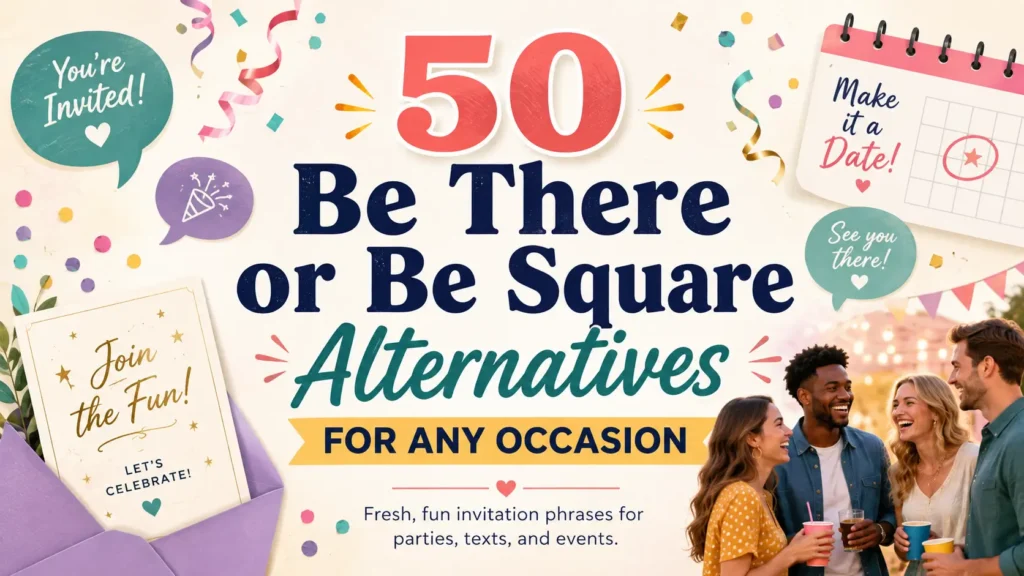

50 Be there or be square alternatives give you fresh, natural ways to invite people without sounding outdated. The meaning of Be There or Be Square is simple: attend an event or risk missing out on the fun. This catchy phrase works as a playful invitation because it is short, funny, and easy to remember. People often use this invitation phrase for a party, school event, social gathering, meetup, or other casual meetups.
It encourages friends to join, show up, and enjoy the event excitement. The wording also creates mild FOMO, making people feel they could miss the fun if they stay away.The phrase became popular through 1950s slang in the USA. At that time, square could describe an old-fashioned, conventional, or uncool person who was not hip. The term appeared around jazz culture, Beatnik circles, and the Beat movement.
Being a square suggested someone was rigid, rule-following, or even boring. The literal square is an orderly shape, which helped create this figurative meaning. Today, the phrase feels more playful than insulting. Modern be-there-or-be-square-alternatives keep the same friendly energy while sounding fresher and more natural.
What Does “Be There or Be Square” Mean?
“Be there or be square” basically means:
Come to the event, or you’ll miss out on the fun.
The phrase isn’t normally meant as a serious insult. It’s playful pressure.
The word square has also been used as slang for someone considered conventional, old-fashioned, dull, or out of touch. That meaning helps explain the joke: attend the exciting event or risk looking boring.
The expression became associated with informal American slang and youth culture during the twentieth century. Today, most people understand it as a deliberately retro phrase rather than cutting-edge slang.
Read this also: What Does IONK Mean in Text? Meaning, Examples, and How to Use It
Is “Be There or Be Square” Still Used Today?
Yes, though usually with a wink.
People still use it for:
- Birthday parties
- Retro-themed events
- Casual invitations
- Social media captions
- Friendly group chats
- Humorous event announcements
However, younger speakers often choose shorter expressions such as “pull up,” “come through,” “don’t miss it,” or “see you there.”
The original expression works best when its old-school flavor is part of the joke.
Quick List of the Best Be There or Be Square Alternatives
If you just need something usable right now, start here.
| Alternative | Tone | Best Use |
| Don’t miss out! | Casual | Parties, promotions |
| Hope to see you there! | Friendly | Everyday invitations |
| Come join us! | Warm | Groups, community events |
| You won’t want to miss this. | Exciting | Promotions, launches |
| Save the date! | Neutral | Event announcements |
| Come through! | Very casual | Friends, texts |
| Pull up! | Slang | Informal gatherings |
| Join us! | Flexible | Almost any event |
| We’d love to have you. | Warm | Personal invitations |
| We hope you can join us. | Professional | Business events |
| See you there! | Confident | Casual invitations |
| Come celebrate with us. | Cheerful | Birthdays, weddings |
| Don’t sit this one out. | Playful | Social events |
| Be part of it. | Inclusive | Campaigns, events |
| Mark your calendar. | Practical | Scheduled events |
The safest all-purpose options are “Hope you can make it,” “Join us,” “See you there,” and “We’d love to have you.”
Casual Alternatives to “Be There or Be Square”
Casual invitations work best when they sound effortless.
You usually don’t need clever wording. You need something your friend could imagine hearing in real conversation.
“Don’t miss out!”
Short, energetic, and familiar.
Use it when you want to create excitement without sounding demanding.
“We’re having everyone over Saturday. Don’t miss out!”
“Hope to see you there!”
This is softer.
Instead of pressuring someone, you’re showing that their presence matters.
It works for birthdays, school events, dinners, reunions, and community gatherings.
“Come join us!”
Simple phrases often win.
“Come join us” feels inclusive because it focuses on belonging rather than exclusion.
“We’re grabbing dinner after work. Come join us!”
“Come hang out!”
This phrase signals a relaxed event.
It’s ideal when there isn’t a strict schedule, dress code, or formal purpose.
“Swing by!”
“Swing by” suggests low commitment.
It’s especially useful for:
- Open houses
- Yard parties
- Store openings
- Casual workplace events
- Neighborhood gatherings
Someone can arrive, stay briefly, and leave without feeling trapped.
“Come through!”
This expression sounds modern and informal.
It’s common among friends and works naturally in texts.
“Game night starts at eight. Come through.”
Avoid it in formal invitations unless your brand intentionally uses a youthful voice.
“Don’t be a stranger!”
This phrase works differently.
It usually invites someone to reconnect rather than attend one specific event.
“We’re around most weekends. Don’t be a stranger!”
“See you there!”
This sounds confident and upbeat.
However, it can imply that you expect the person to attend.
Use it when someone has already shown interest.
“Come on over!”
Perfect for home gatherings.
It sounds warm and personal without needing any extra decoration.
“Join the fun!”
Family-friendly, upbeat, and flexible.
It suits festivals, children’s events, parties, games, and casual promotions.
Funny and Playful Ways to Say It
Humor works when you already have some rapport with your audience.
The trick is to make people smile without sounding like you’re emotionally blackmailing them into showing up.
Here are several playful options:
- “Show up or hear about it later!”
- “Don’t make us have fun without you.”
- “Skip it at your own risk.”
- “The party won’t be the same without you.”
- “Come for the fun, stay for the memories.”
- “Show up and join the chaos.”
- “Come make some questionable memories.”
- “Your future self will be glad you came.”
- “Come for the vibes.”
- “Good times are calling.”
The audience matters.
“Come make some questionable memories” might get a laugh in a college group chat. The same line would feel wildly misplaced on an invitation to a retirement luncheon.
Mini Case Study: The Birthday Group Chat
Imagine someone writes:
“My birthday is Friday at 8. Attendance is strongly encouraged.”
Technically, it works.
Emotionally? It sounds like a staff meeting.
Now compare:
“Birthday chaos starts Friday at 8. Don’t make us have fun without you.”
The second version gives the invitation personality. It also creates gentle FOMO without sounding hostile.
The lesson is simple: match your wording to the relationship.
Modern and Catchy Invitation Phrases
Some situations need energy without retro slang.
That’s where modern alternatives shine.
“You won’t want to miss this.”
This phrase creates mild FOMO.
It works especially well for:
- Product launches
- Performances
- Sales events
- Conferences
- Special announcements
Use it only when the event genuinely offers something worthwhile. Constantly telling people everything is “unmissable” weakens your credibility.
“Don’t miss the moment.”
This sounds slightly more emotional.
It works well for milestone events, celebrations, launches, or community occasions.
“Make sure you’re there.”
Direct and confident.
Because it’s stronger than “hope you can make it,” use it with audiences who already expect informal communication.
“Save the date!”
One of the most practical alternatives.
It doesn’t pressure the reader. Instead, it tells them an important date is coming.
“Mark your calendar.”
Similar to “save the date,” though slightly more practical and less celebratory.
“This is one you’ll want to catch.”
Great for entertainment.
Think concerts, comedy shows, livestreams, sporting events, and special presentations.
“Join us for something special.”
Warm without becoming overly emotional.
It also works across different age groups.
“Don’t sit this one out.”
This keeps some of the playful challenge found in the original phrase.
It works for sports, social activities, and group events.
“Get in on the action.”
Energetic wording suits events built around participation.
“Be part of it.”
Short. Inclusive. Adaptable.
Brands often benefit from this kind of language because it places the reader inside the experience.
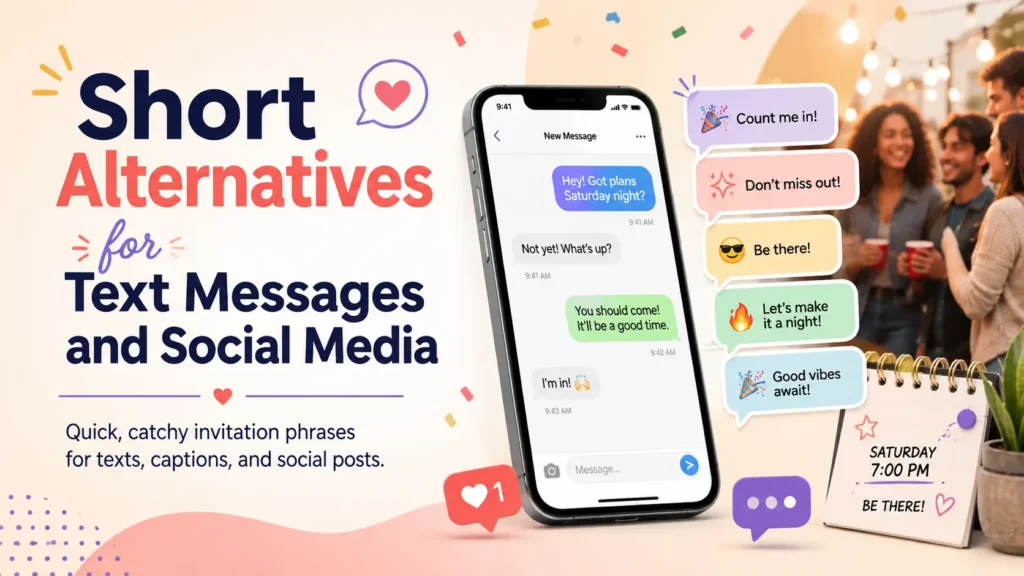
Short Alternatives for Text Messages and Social Media
People read texts and captions quickly.
That changes what works.
Long invitation copy can feel heavy when a three-word phrase would do the job.
Try:
- Pull up!
- See you there!
- Don’t miss it!
- Come through!
- Join us!
- Be there!
- Who’s in?
- See you at the party!
“Who’s in?” deserves special attention.
Unlike a normal invitation, it encourages a response. That makes it useful in group chats where you’re trying to estimate attendance.
“Tacos Friday night. Who’s in?”
Short. Clear. Easy to answer.
Warm and Friendly Alternatives
Not every invitation needs urgency.
Sometimes you want the person to feel genuinely wanted.
Try these:
“We’d love to have you.”
Warm without being dramatic.
It works especially well for dinners, gatherings, ceremonies, and family events.
“It would be great to see you.”
Excellent when the relationship matters more than the event.
Use it for reunions, old friends, former colleagues, or relatives you haven’t seen recently.
“Hope you can make it!”
Possibly the most versatile casual invitation phrase.
It gives the recipient room to decline without embarrassment.
“We hope you’ll join us.”
A little more polished.
This phrase can move comfortably between personal and professional situations.
“It wouldn’t be the same without you.”
Use this for people whose presence really matters.
Because the phrase carries emotional weight, reserve it for close relationships.
“Come celebrate with us.”
Perfect for:
- Weddings
- Birthdays
- Graduations
- Anniversaries
- Engagements
- Retirement parties
- Baby showers
It clearly tells the reader what they’re being invited to do.
Professional and Formal Alternatives
Professional invitations need clarity before cleverness.
A conference attendee doesn’t need to wonder whether “pull up” means RSVP, walk in, or bring a folding chair.
“We hope you can join us.”
Professional, friendly, and flexible.
“We look forward to seeing you.”
Best when the recipient has already registered or indicated attendance.
“Please join us for…”
This remains one of the clearest formal invitation structures.
“Please join us for our annual client appreciation dinner.”
“You’re warmly invited to join us.”
A little more ceremonial.
It works well for formal receptions and special events.
“We would be delighted to have you join us.”
Polished and gracious.
Use it when the event carries significance.
“Your presence would be greatly appreciated.”
This is more reserved and formal.
It may suit institutional events, ceremonies, or official gatherings.
Mini Case Study: Casual Language in a Business Invite
Consider this line:
“Quarterly leadership summit. Be there or be square!”
For an internal startup event, it might work.
For external executives, it risks sounding unserious.
Now compare:
“Please join us for our quarterly leadership summit. We look forward to exchanging ideas with industry peers.”
The second version matches the stakes.
A good invitation doesn’t merely sound nice. It signals what kind of event the recipient should expect.
Which Alternative Should You Use?
Your relationship with the audience should drive the choice.
| Situation | Strong Choice |
| Party with friends | Come join the fun! |
| Casual text | Come through! |
| Instagram post | Don’t miss it! |
| Birthday | Come celebrate with us. |
| Wedding | We’d love to have you join us. |
| Business event | We hope you can join us. |
| Product launch | You won’t want to miss this. |
| Open house | Swing by! |
| Reunion | It would be great to see you. |
| Group chat | Who’s in? |
| Concert | This is one you’ll want to catch. |
| Family dinner | Hope you can make it! |
Think of invitation wording like clothing.
A hoodie isn’t bad because you wouldn’t wear it to a black-tie dinner. It simply belongs in a different room.
Language works the same way.
Be There or Be Square Alternatives Based on Tone
The easiest way to choose a phrase is to decide how you want to sound.
Read this also: Reply to Happy Friendship Day Wishes: Heartfelt, Funny & Thoughtful Responses
If You Want to Sound Funny
Use:
- “Don’t make us have fun without you.”
- “Skip it at your own risk.”
- “Show up or hear about it later!”
- “Come join the chaos.”
Humor works best with familiar audiences.
If You Want to Sound Friendly
Choose:
- “Hope you can make it!”
- “We’d love to have you.”
- “Come join us!”
- “It would be great to see you.”
These phrases make people feel welcomed rather than pressured.
If You Want to Create Excitement
Try:
- “You won’t want to miss this.”
- “Get in on the action.”
- “Don’t miss the moment.”
- “Be part of it.”
Strong verbs make invitations feel more active.
If You Want to Sound Professional
Use:
- “We hope you can join us.”
- “Please join us for…”
- “We look forward to seeing you.”
- “You’re warmly invited.”
Professional doesn’t have to mean cold.
If You Want Something Short
Keep it simple:
- “Join us!”
- “See you there!”
- “Don’t miss it!”
- “Be there!”
- “Who’s in?”
How to Replace the Phrase Without Sounding Awkward
Finding a replacement isn’t about swapping one sentence for another.
You need to preserve the intent.
Ask yourself three questions.
Who Am I Talking To?
A friend may appreciate slang.
A client may prefer direct, polished wording.
Your grandmother might understand “pull up,” though she may also wonder where she’s supposed to park.
What Kind of Event Is It?
A backyard barbecue gives you freedom.
A memorial service doesn’t.
A business conference needs clarity. A themed birthday party can handle wordplay.
What Reaction Do I Want?
Different wording creates different emotions.
- Warmth: “We’d love to have you.”
- Urgency: “Don’t miss it.”
- Excitement: “Get in on the action.”
- Belonging: “Be part of it.”
- Humor: “Don’t make us have fun without you.”
Once you know the intended reaction, choosing the phrase becomes much easier.
Invitation Phrases You Should Avoid
Competitor lists often include expressions that technically resemble the original phrase yet sound unnatural in real conversation.
That’s worth avoiding.
Forced Rhymes
Phrases such as:
“Attend or lament!”
may rhyme nicely, though few people naturally speak that way.
Rhyming isn’t enough. The phrase still needs to sound believable.
Confusing Geometry Jokes
Expressions such as:
- “Be square as a cube”
- “Come along or be square-shaped”
- “Be geometrically challenged”
can work as intentional absurdist humor.
Otherwise, they sound more confusing than clever.
Overly Negative Invitations
Avoid making guests feel punished for declining.
“Come or you’ll regret it forever” creates pressure rather than excitement.
Healthy FOMO says:
“You won’t want to miss this.”
Uncomfortable pressure says:
“You’ll be sorry if you don’t come.”
There’s a real difference.
Slang That Doesn’t Fit Your Audience
Slang ages quickly and varies by group.
“Pull up” may sound natural among friends. On a formal wedding invitation, it may feel forced.
Good writing respects context.
Frequently Asked Questions
Q1: What does “be there or be square” mean?
It means you should attend an event or risk missing out on the fun. The phrase usually sounds playful rather than insulting.
Q2: What can I say instead of “be there or be square”?
You can say “don’t miss out,” “hope you can make it,” “join the fun,” “see you there,” or “we’d love to have you.”
Q3: Is “be there or be square” still used today?
Yes. People still use it jokingly for parties, casual events, school gatherings, and retro-themed invitations.
Q4: Why does “square” mean uncool?
In older American slang, “square” described someone seen as conventional, old-fashioned, or out of touch with popular culture.
Q5: What is a funny alternative to “be there or be square”?
Try “show up or hear about it later,” “don’t make us have fun without you,” or “skip it at your own risk.”
Q6: What is a modern alternative to “be there or be square”?
Modern options include “pull up,” “come through,” “don’t miss it,” “be part of it,” and “you won’t want to miss this.”
Q7: What is a formal alternative to “be there or be square”?
You can use “we hope you can join us,” “please join us for the event,” or “we look forward to seeing you.”
Q8: Can I use “be there or be square” on a party invitation?
Yes. It works especially well for casual parties, birthdays, school events, and gatherings where a playful tone feels appropriate.
Q9: Is “be there or be square” rude?
Usually not. Most people understand it as friendly teasing. Still, it may feel too casual for formal or serious occasions.
Q10: How do I choose the best invitation phrase?
Think about your relationship with the reader, the type of event, and the tone you want. Casual events allow more humor, while formal events need warmer and clearer wording.
Final Thoughts
“Be there or be square” is still a fun and recognizable phrase, though it can sound a little old-fashioned today. The right alternative depends on your audience, event, and tone. For casual gatherings, phrases like “come through,” “don’t miss out,” or “join the fun” work well. For formal occasions, “we hope you can join us” or “we’d love to have you” sounds more natural. The best invitation wording should feel clear, friendly, and suited to the people receiving it.
Blog :