
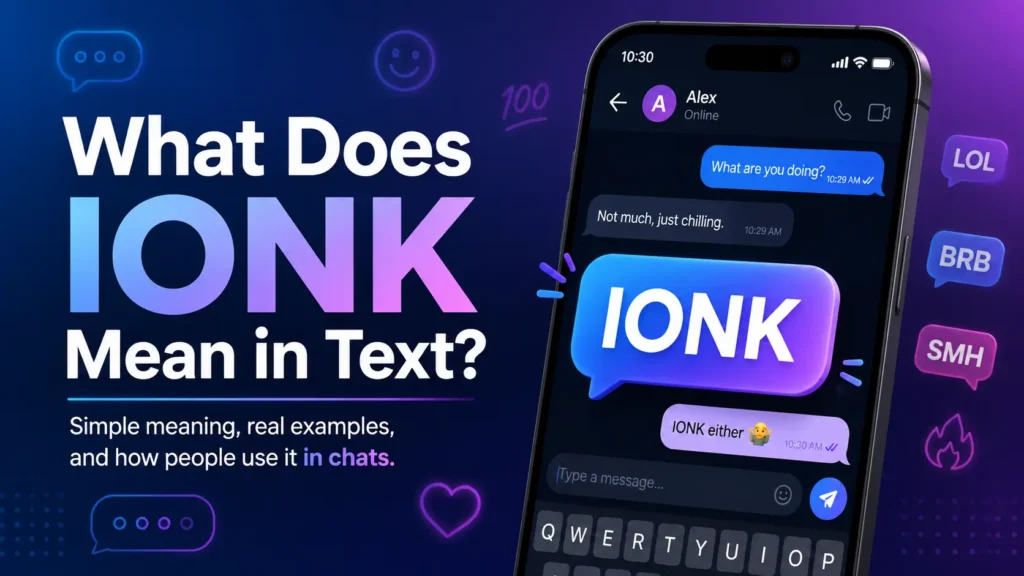

If you’re wondering what does IONK mean in text, it usually means “I don’t know.” You may see IONK in text messages, DMs, group chats, TikTok comments, Snapchat conversations, and casual online replies. At first, the spelling may look unusual. However, it makes more sense when you connect it with “ion,” a slang form of “I don’t.”
For example, someone might text, “ionk where he went.” In normal English, that means, “I don’t know where he went.” Therefore, IONK works as a quick, speech-like way to show uncertainty without typing the full phrase.
Some websites also give IONK alternate meanings such as “I Only Now Know.” However, that meaning is much less common. In everyday slang, “I don’t know” is the safer meaning unless the surrounding conversation clearly suggests something else.
What Does IONK Mean in Text?
If you’re wondering what does IONK mean in text, the simplest answer is “I don’t know.” People use it when they lack information, feel unsure, or don’t have a clear answer.
For example:
- “ionk where she is.”
- “ionk if I’m going tonight.”
- “ionk honestly.”
- “ionk what happened.”
- “ionk yet, lemme check.”
In each case, the speaker expresses uncertainty. However, the emotional tone can change. Punctuation, emojis, and surrounding words can make IONK sound relaxed, funny, confused, hesitant, or even dismissive.
Read this also: Reply to Happy Friendship Day Wishes: Heartfelt, Funny & Thoughtful Responses
Quick Meaning of IONK
| Term | Meaning | Tone | Common Use |
|---|---|---|---|
| IONK | I don’t know | Very casual | Texts, DMs, comments |
| IDK | I don’t know | Casual | General online conversation |
| ION | I don’t | Very casual | Speech-like texting |
| IDEK | I don’t even know | More expressive | Confusion or frustration |
Therefore, IONK and IDK often communicate the same basic message. Still, they don’t always feel the same.
What Does IONK Stand For?
IONK is often described as an abbreviation for “I don’t know.” However, it doesn’t work like a traditional initialism.
For comparison, IDK directly takes the first letters of I Don’t Know. IONK appears to grow from speech-like spelling instead. The form ion is documented as an informal representation of “I don’t,” especially in Black English. As a result, phrases such as “ion know” represent the spoken rhythm of “I don’t know.”
That gives us a useful way to understand the term:
I don’t know → ion know → ionk
This isn’t a proven step-by-step historical timeline. Instead, it shows the linguistic relationship between the forms.
Is IONK an Acronym?
Not exactly.
A traditional acronym or initialism normally comes from the first letters of a phrase. For example, LOL comes from “laughing out loud,” while IDK comes from “I don’t know.”
IONK behaves differently. Instead, it works more like phonetic slang or speech-based shorthand. People spell the phrase in a way that reflects casual pronunciation.
Therefore, describing IONK as “texting slang for I don’t know” is usually clearer than treating it as a strict acronym.
Does IONK Mean “I Only Now Know”?
You may see “I Only Now Know” listed as another IONK meaning. However, this interpretation appears mainly on some slang and meaning websites rather than as the dominant everyday use.
For example, a person could theoretically write IONK after suddenly learning something. Still, most casual uses of “ionk” make much more sense as “I don’t know.”
If the sentence becomes confusing, use context. Ask yourself whether “I don’t know” fits naturally. In most cases, it will.
Where Does IONK Come From?
IONK doesn’t have one confirmed inventor or a clearly documented birthday. However, its connection with ion helps explain where the spelling comes from.
The slang ion represents “I don’t” in casual writing. For example:
- “ion care” = “I don’t care”
- “ion want it” = “I don’t want it”
- “ion remember” = “I don’t remember”
- “ion think so” = “I don’t think so”
- “ion know” = “I don’t know”
As texting and social media encouraged shorter, faster writing, speech-like spellings became easier to share. Therefore, forms such as ion, ion know, and ionk fit naturally into casual digital conversation.
However, it’s better to avoid dramatic claims about exactly when IONK “went viral” or which platform created it. Slang usually spreads through overlapping communities rather than one single source.
How Is IONK Used in Texting?
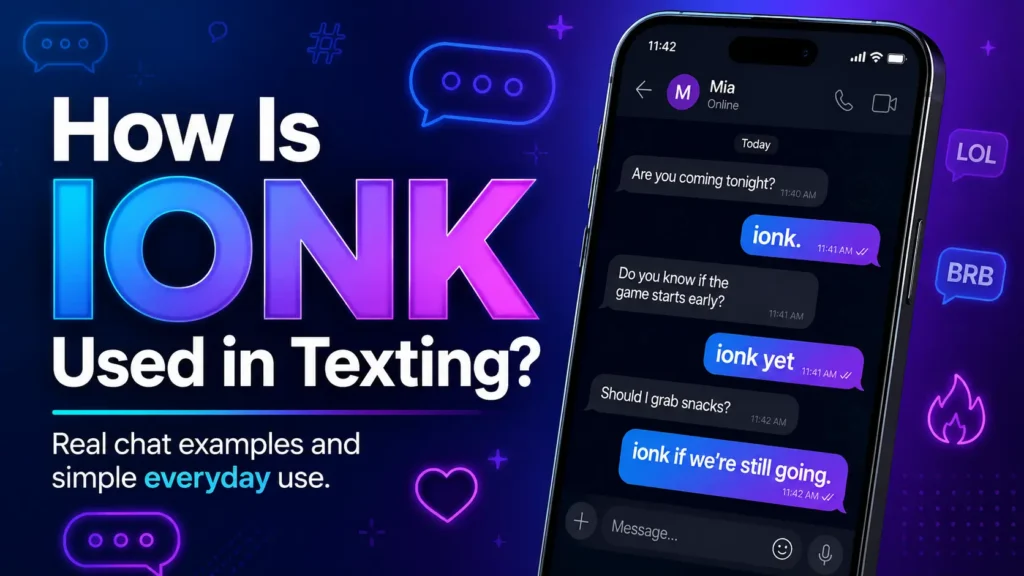
IONK can work as a complete reply or as part of a longer sentence. Therefore, its placement depends on what the speaker wants to say.
IONK as a Short Reply
Alex: “Who changed the Wi-Fi password?”
Chris: “ionk.”
Here, Chris simply means “I don’t know.”
The answer is short and direct. However, in a relaxed conversation, it doesn’t necessarily sound rude.
IONK Before More Information
“ionk if we’re still going.”
In other words, the sender means:
“I don’t know if we’re still going.”
The extra words explain what the person feels uncertain about.
IONK When Giving an Opinion
“ionk, the first season was better.”
Here, IONK doesn’t only show a lack of factual information. Instead, it can soften an opinion, much like saying, “I don’t know… I think the first season was better.”
Therefore, the expression can communicate hesitation as well as uncertainty.
Examples of IONK in Real Conversations
Seeing IONK inside realistic conversations makes its meaning easier to understand.
Between Friends
Sam: “What time does the movie start?”
Ryan: “ionk yet, lemme check.”
Ryan doesn’t know right now. However, he plans to find out.
In a Group Chat
Maya: “Who changed the group picture?”
Leo: “ionk 😂”
Because of the laughing emoji, Leo’s response feels light and playful.
When Making Plans
Ava: “You coming Saturday?”
Noah: “ionk yet. I gotta check.”
Here, IONK shows uncertainty rather than rejection. Therefore, Ava shouldn’t automatically read the answer as “no.”
On Social Media
Comment: “Why is everyone arguing about this?”
Reply: “ionk at this point 😭”
The crying emoji adds an exhausted or humorous tone. As a result, the reply feels more expressive than a plain “I don’t know.”
Mini Case Study: Context Changes Everything
Imagine your friend asks, “Where should we eat?”
You reply:
“ionk.”
That answer probably sounds normal.
However, imagine your manager asks, “Why was the customer’s order canceled?”
If you answer only:
“ionk.”
the same slang may sound careless.
Therefore, context matters more than the word alone. The relationship, situation, and seriousness of the question all affect how people read your message.
IONK vs. IDK: What’s the Difference?
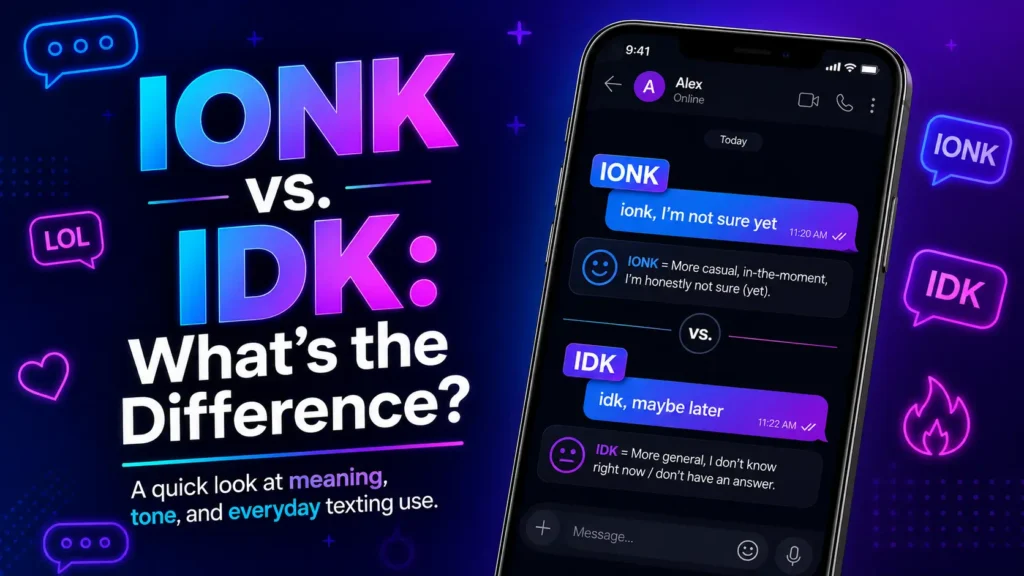
IONK and IDK usually share the same core meaning: “I don’t know.” However, their style differs.
| Feature | IONK | IDK |
|---|---|---|
| Meaning | I don’t know | I don’t know |
| Style | Speech-like slang | Standard texting shorthand |
| Familiarity | Less widely recognized | Very widely recognized |
| Tone | Casual and expressive | Casual and neutral |
| Best use | Friends, comments, DMs | Most informal digital chats |
IDK is easier for a broad audience to understand. Meanwhile, IONK feels more connected with spoken slang.
For example:
“IDK if he’s coming.”
sounds like familiar texting shorthand.
In contrast:
“ionk if he coming.”
feels more speech-like and informal.
Therefore, choose IDK when clarity matters. Choose IONK when the conversation already uses relaxed slang.
ION vs. IONK: What’s the Difference?
ION and IONK are closely related. However, they don’t perform exactly the same job.
ION usually means “I don’t.” Therefore, another word often follows it.
Examples include:
- “ion care”
- “ion remember”
- “ion want that”
- “ion think so”
- “ion know”
IONK, on the other hand, commonly carries the full idea “I don’t know.”
For example:
- “ionk.”
- “ionk yet.”
- “ionk about that.”
- “ionk if she coming.”
A simple memory trick is:
ION needs another idea after it. IONK can stand alone.
IONK vs. Similar Texting Slang
Several texting expressions communicate uncertainty. However, each one carries a slightly different feel.
| Slang | Meaning | Main Difference |
|---|---|---|
| IONK | I don’t know | Very casual and speech-like |
| IDK | I don’t know | Most familiar shorthand |
| IDEK | I don’t even know | Adds stronger emotion |
| Dunno | Don’t know | Casual spoken-style spelling |
| Ion know | I don’t know | Longer speech-like form |
| Not sure | I’m uncertain | Clearer and more neutral |
For instance, “IDEK anymore” may sound more frustrated or overwhelmed than “IDK.”
Meanwhile, “not sure” works better when you want to sound neutral without becoming formal.
Common IONK Variations
Online slang rarely follows strict capitalization or spelling rules. Therefore, you may see several versions:
- ionk
- IONK
- IonK
- ion know
- ion kno
- ionk yet
- ion even know
Usually, capitalization doesn’t change the core meaning. However, it can change the emotional force.
For example:
“ionk”
feels calm and casual.
Meanwhile:
“IONK 😭”
may feel more dramatic, frustrated, or humorous.
Therefore, look at the whole message rather than one word.
What Does IONK Mean on Snapchat, TikTok, Instagram, and WhatsApp?
The platform usually doesn’t change IONK’s basic meaning. Instead, the setting changes how people use it.
On Snapchat, someone may send:
“ionk where he at.”
On TikTok, a person might comment:
“ionk what I just watched 💀”
On Instagram, someone could reply to a story:
“ionk how you did that.”
Meanwhile, on WhatsApp or Discord, IONK may appear during planning, gaming chats, or casual group discussions.
In all these examples, the main idea remains “I don’t know.” However, emojis and context can make the response sound funny, confused, or hesitant.
What Tone Does IONK Have?
IONK doesn’t carry one fixed emotional tone. Instead, context acts like digital body language.
Casual
“ionk lol.”
The speaker sounds relaxed.
Confused
“ionk what’s happening 😭”
Here, the person seems genuinely lost.
Hesitant
“ionk if I wanna go.”
The sender hasn’t made a decision yet.
Dismissive
“ionk.”
During a serious conversation, that one-word reply might sound uninterested.
Therefore, punctuation, emojis, and extra words matter. A tiny change can make the same slang feel warm or cold.
Can IONK Sound Rude?
IONK isn’t inherently rude. However, a very short answer can sound dismissive when someone expects effort, care, or useful information.
Compare:
“ionk.”
with:
“ionk yet, but I can check.”
Both responses admit uncertainty. Still, the second sounds much more helpful.
IONK usually works well when you’re:
- chatting with close friends
- joking around
- answering a simple question
- commenting casually online
- talking in an informal group chat
However, avoid it during:
- serious relationship discussions
- workplace conversations
- customer complaints
- formal school communication
- sensitive personal situations
- important requests for information
How to Make IONK Sound Friendlier
Add a little context.
For example:
- “ionk yet, but I’ll find out.”
- “ionk honestly 😂”
- “ionk, maybe ask Chris?”
- “ionk for sure. I’ll check.”
- “ionk either 😭”
As a result, the reply feels less cold and more cooperative.
When Should You Use IONK?
Use IONK when the conversation already feels informal and the reader understands casual slang.
Good situations include:
- texting close friends
- casual DMs
- Snapchat chats
- TikTok comments
- Instagram replies
- Discord conversations
- gaming chats
- informal group messages
However, don’t use slang simply because it looks trendy. If your reader may not understand IONK, a plain “IDK” or “I’m not sure” will communicate the message more clearly.
When Should You Avoid IONK?
Avoid IONK whenever clarity, professionalism, or respect matters more than casual style.
For example, skip it in:
- job applications
- professional emails
- business reports
- school assignments
- customer service messages
- official documents
- important workplace conversations
Instead of writing:
“ionk when the report will be ready.”
write:
“I’m not sure when the report will be ready. I’ll confirm the timeline.”
As a result, you sound responsible rather than careless.
How Do You Respond When Someone Says IONK?
Your response depends on what you need from the conversation.
If you still need an answer, try:
- “Can you check?”
- “Who would know?”
- “Can you find out?”
- “No worries. I’ll ask someone else.”
If the answer isn’t important, you can reply:
- “Fair enough.”
- “Same 😂”
- “Okay lol.”
- “No worries.”
However, if the sender seems confused, give more context. Sometimes a clearer question solves the problem faster than asking the same thing again.
Common Misunderstandings About IONK
“IONK and ION Mean Exactly the Same Thing”
Not quite.
ION generally means “I don’t,” while IONK usually communicates “I don’t know.” Therefore, ION often needs another word after it.
“IONK Has a Different Meaning on Every App”
Usually, no.
Snapchat, TikTok, Instagram, and Discord change the setting. However, they don’t automatically change the definition.
“IONK Is Always Rude”
No.
A casual “ionk 😂” can sound playful. In contrast, a dry “ionk.” during an important conversation can feel dismissive.
“IONK Always Means I Only Now Know”
That interpretation appears online, but it isn’t the meaning you should assume first. Instead, “I don’t know” fits the dominant casual use more reliably.
Quick Facts About IONK
| Question | Quick Answer |
|---|---|
| What does IONK mean? | I don’t know |
| Is IONK slang? | Yes |
| Is it formal? | No |
| Is IONK the same as IDK? | Usually in meaning |
| What does ION mean? | I don’t |
| Is IONK rude? | Not by itself |
| Can you use IONK at work? | Usually best avoided |
| Does the meaning change by platform? | Usually no |
| Is “I Only Now Know” possible? | Rare or context-dependent |
| Is IONK a standard acronym? | Better viewed as speech-like slang |
FAQs About IONK Meaning in Text
Q1: What does IONK mean in text?
IONK usually means “I don’t know.” People use it when they’re unsure, confused, or don’t have enough information to answer.
Q2: Is IONK the same as IDK?
Usually, yes. Both communicate “I don’t know.” However, IDK is more familiar, while IONK feels more speech-like and informal.
Q3: What does ION mean in texting?
ION commonly means “I don’t.” For example, “ion care” means “I don’t care,” while “ion know” means “I don’t know.”
Q4: Is IONK an acronym?
Not in the traditional sense. Instead, it works better as phonetic or speech-based texting slang.
Q5: Does IONK mean “I Only Now Know”?
Some websites use that interpretation. However, it is less common than “I don’t know,” so context should guide you.
Q6: What does IONK mean on Snapchat?
On Snapchat, IONK usually means “I don’t know.” People often use it as a quick response in casual chats.
Q7: What does IONK mean on TikTok?
On TikTok, IONK may appear in comments, captions, or replies. Again, it usually expresses uncertainty or a lack of information.
Q8: Is IONK rude?
Not automatically. However, a one-word “ionk” can sound dismissive during a serious or emotional conversation.
Q9: Can I use IONK in professional messages?
Usually, no. Instead, use clearer phrases such as “I’m not sure,” “I’ll check,” or “I don’t have that information yet.”
Q10: How should I respond when someone says IONK?
If you still need the answer, ask whether they can check or suggest someone else who may know. Otherwise, a simple “no worries” works well.
Conclusion: Understanding IONK
Understanding What Does IONK Mean in Text? Meaning, Examples, and How to Use It becomes easy once you focus on context. In most casual messages, IONK means “I don’t know.” It works as an informal, speech-like shortcut rather than a formal abbreviation.
However, tone still matters. IONK can sound playful, uncertain, funny, hesitant, or dismissive depending on the situation. Therefore, use it with friends, in casual DMs, or in relaxed social media conversations. In professional settings, choose clearer language such as “I’m not sure” or “I’ll check.”
Ultimately, you don’t need to overthink it. When someone texts “ionk,” the safest reading is usually simple: they don’t know.
Blog :