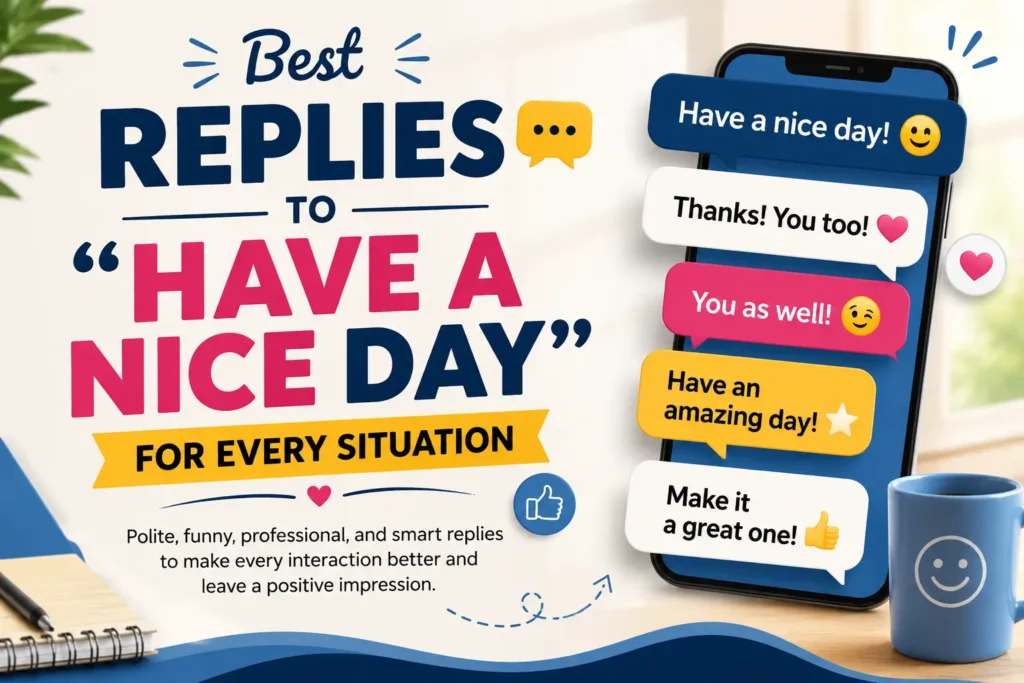

When someone tells You to have a nice day, Best Replies to “Have a Nice Day” for Every Situation should match the situation and tone. A simple “Thanks, you too!” can show respect, kindness, and appreciation. It can also make people feel happy and appreciated. With friends, a casual, funny, or playful response adds humor.
At work, a professional and polite reply sounds appropriate. In texts, a warm and personal response can make the conversation more meaningful and engaging.The right replies don’t need complicated words. Instead, choose a natural response that fits the context.
A thoughtful reply can help you connect with people, build stronger relationships, and create a positive moment. Whether you’re at school, home, work, or anywhere, good communication makes a difference.Don’t overthink every expression. A little care, courtesy, and friendliness can make someone smile. Sometimes, “Thanks! You too!” is all you need to leave a memorable impression.
What Does “Have a Nice Day” Mean?
At its most basic level, “Have a nice day” means “I hope the rest of your day goes well.”
People commonly use it when ending an interaction. You might hear it from a cashier after paying for groceries, a receptionist after an appointment, a coworker leaving the office, or a friend ending a conversation.
The phrase can also function as a routine courtesy rather than a deeply personal wish. That doesn’t make it meaningless. In many situations, its purpose is simply to close an interaction on a pleasant note.
Interestingly, “have a nice day” has developed some cultural baggage. Repeated use in customer service has sometimes made it sound automatic or impersonal. In certain contexts, people can even use it sarcastically to end an argument or dismiss a conversation.
Read this also: White Heart Emoji Meaning : What It Means in Texting, Love & Social Media
That means context matters more than the words alone.
| Situation | Likely Meaning |
| Cashier says it | Friendly farewell |
| Coworker says it | Pleasant workplace goodbye |
| Friend says it | Warm or casual good wish |
| Romantic interest says it | Could be warm or subtly affectionate |
| Customer-service agent says it | Professional closing |
| Someone says it after an argument | Could sound dismissive or sarcastic |
What Is the Best Reply to “Have a Nice Day”?
For most situations, “Thanks, you too!” wins.
It’s short, polite, and reciprocal. You acknowledge the person’s good wish and return it without making the interaction unnecessarily long.
Other reliable choices include:
- “Thank you, you too!”
- “Thanks! Same to you.”
- “You too! Take care.”
- “Thanks, have a great one!”
- “I appreciate it. You too!”
- “Thanks! Hope you have a good day too.”
- “Thank you. Enjoy the rest of your day.”
- “Same to you!”
The key isn’t finding one magical sentence. It’s choosing the response that matches the relationship.
Short and Simple Replies
Sometimes the conversation is already ending. In those moments, brevity works best.
Try:
- “You too!”
- “Thanks, you too!”
- “Thanks!”
- “Same to you!”
- “You as well!”
- “Appreciate it!”
- “Take care!”
- “Thanks, have a good one!”
“Thanks, you too!” is especially useful because it combines appreciation with reciprocity.
There’s no need to turn a two-second farewell into a speech.
Polite and Friendly Replies
When you want to sound a little warmer, add a few words without making the response complicated.
Good examples include:
- “Thanks! Hope you have a great day too.”
- “Thank you! Enjoy the rest of your day.”
- “Thanks, I hope yours goes well too.”
- “I appreciate that. Have a wonderful day.”
- “Thanks! Take care and enjoy your day.”
- “That’s kind of you. You too!”
These work well with neighbors, acquaintances, receptionists, service workers, and people you meet regularly.
Warm and Thoughtful Replies
A thoughtful reply makes more sense when someone has genuinely helped you.
For example, if a receptionist goes out of their way to solve a problem, you could say:
“Thank you for your help. I really appreciate it. Have a great day too.”
That’s more meaningful than simply saying “you too” because it recognizes what happened during the conversation.
Other options:
- “Thank you! I really appreciate your kindness. Have a great day too.”
- “Thanks for your help. I hope the rest of your day goes smoothly.”
- “That’s very kind of you. Wishing you a great day as well.”
- “Thank you. I hope today treats you well too.”
The trick is specificity. A genuine acknowledgment often sounds better than a pile of enthusiastic adjectives.
Professional Replies to “Have a Nice Day”
Workplace conversations require a slightly different touch.
You want to sound pleasant without becoming overly familiar. Fortunately, professional replies don’t need to sound stiff.
Useful examples include:
- “Thank you. Have a great day as well.”
- “Thanks! I hope you have a productive day too.”
- “Thank you. Enjoy the rest of your day.”
- “Thanks, you too. Take care.”
- “I appreciate it. Have a good afternoon.”
- “Thank you. Wishing you a pleasant day as well.”
For a manager or client, “Thank you. Have a great day as well” is a safe choice.
For a coworker you know well, something simpler such as “Thanks, you too!” usually sounds more natural.
Professional Email Replies
Email requires a little more care because the written tone can feel more formal than spoken conversation.
If someone ends an email with “Have a nice day,” you don’t always need to repeat the exact phrase. You can close naturally with:
- “Thank you, and have a great day.”
- “Thanks again. Enjoy the rest of your day.”
- “Appreciate your help. Have a good afternoon.”
- “Thank you. Wishing you a pleasant day.”
- “Thanks, and I hope you have a productive afternoon.”
Avoid unnecessarily elaborate wording such as “May you experience an exceptionally pleasant and productive remainder of your chronological day.”
That’s technically polite. It also sounds like a robot wearing a tie.
Casual Replies for Friends
Friends give you more freedom.
You can keep the reply simple:
- “You too!”
- “Thanks! You have a good one.”
- “You too, buddy!”
- “Thanks! Enjoy your day.”
- “Same to you!”
- “Thanks! Go make it a good one.”
If your friendship includes plenty of joking, you can have more fun with it.
- “I’ll do my best.”
- “No promises, but I’ll try.”
- “That’s the plan!”
- “You too. Stay out of trouble.”
- “Thanks! Let’s see what today brings.”
The humor works because the relationship already gives you room to be playful.
Funny and Witty Replies to “Have a Nice Day”
Humor can turn a routine farewell into a memorable exchange.
The safest funny replies are light rather than sarcastic:
- “I’ll certainly try!”
- “That’s the goal.”
- “Fingers crossed!”
- “Thanks. I’ve got high hopes.”
- “You too. Make it legendary.”
- “Thanks! Let’s hope the coffee cooperates.”
- “I’ll accept that assignment.”
- “Challenge accepted.”
- “Thanks. May the day be kind to both of us.”
However, humor depends heavily on tone.
A joke that makes a close friend laugh might confuse a stranger. Likewise, sarcasm can sound rude when someone is simply being courteous.
Cute and Playful Replies
If the conversation is relaxed, a cute response can add personality.
Try:
- “Thanks! You just made my day a little better.”
- “Aww, thanks. You too!”
- “Thanks! I hope yours is extra good.”
- “You too! Go have a lovely one.”
- “Thanks! Sending the good-day energy right back.”
- “I will if you do.”
These responses work especially well in text messages because digital conversations don’t carry facial expressions or vocal tone.
A small emoji can also help:
- “Thanks! You too 😊”
- “Have a great one! ☀️”
- “You too! Hope it’s a good one 😊”
Don’t overdo it. One natural emoji usually works better than a parade of them.
Flirty Replies to “Have a Nice Day”
A flirty response should reflect the existing relationship.
If you’re unsure whether the other person is interested, start subtle. You don’t need to turn a simple goodbye into a declaration of love.
Subtle Flirty Replies
- “Thanks! Hope yours is even better.”
- “I will. Especially after hearing that from you.”
- “Thanks! You just gave me a reason to smile.”
- “You too. Maybe I’ll see you later?”
- “Thanks. I hope I get to talk to you again today.”
More Direct Flirty Replies
- “It would be even nicer if I got to spend some of it with you.”
- “Thanks! Seeing you would definitely improve it.”
- “You too. Save a little of that good mood for me.”
- “I’ll try, but you’re already making it difficult to focus.”
Use these only when the relationship supports that level of flirtation.
A clever line isn’t clever anymore if it makes the other person uncomfortable.
How to Reply Based on Who Said It
The same words can deserve very different responses depending on the speaker.
When a Friend Says It
Keep things relaxed:
“Thanks, you too! Have a good one.”
When a Coworker Says It
Stay friendly and professional:
“Thanks! You too.”
When Your Boss Says It
A simple professional response works:
“Thank you. Have a great day as well.”
When a Customer Says It
Return the courtesy:
“Thank you! You too.”
When a Stranger Says It
There’s no need to overcomplicate things:
“Thanks, you too!”
When Someone You Like Says It
You can add warmth:
“Thanks! I hope you have a great day too. Talk later?”
This approach shows interest while keeping the conversation natural.
Read this also: Soda Tab Meaning: Definition, Slang, History, and Uses
How to Respond in Different Situations
In Person
Your delivery matters almost as much as your words.
A relaxed “Thanks, you too!” with a smile sounds warmer than the same sentence delivered while staring at your phone.
You don’t need theatrical enthusiasm. A genuine tone is enough.
Over Text
Text gives you more freedom to show personality.
For example:
Them: “Have a nice day 😊”
You: “Thanks! You too. Hope today treats you well 😊”
Or, if you’re close:
Them: “Have a nice day!”
You: “I’ll try 😂 You too!”
After a Great Conversation
When someone has made your day better, acknowledge it.
“Thanks! I really enjoyed talking with you. Have a great day too.”
That response does more than return a courtesy. It confirms that you valued the interaction.
When You’re in a Hurry
Keep it clean:
- “Thanks, you too!”
- “You too!”
- “Thanks! Take care.”
There’s nothing rude about being brief when you’re clearly moving on.
What If You’re Not Having a Nice Day?
Not every day deserves a cheerful performance.
If someone says “Have a nice day” while you’re dealing with something difficult, you can still respond honestly without dumping your problems into a casual interaction.
Consider:
- “Thanks. I’m hoping it gets better.”
- “I appreciate that. It’s been a rough morning.”
- “Thanks. Hopefully the rest of the day goes smoothly.”
- “Thank you. I’m taking it one step at a time.”
- “I appreciate it. Have a good one too.”
The best response depends on how well you know the person.
A close friend might deserve an honest explanation. A cashier probably doesn’t need the entire story.
Better Alternatives to “You Too”
“You too” isn’t boring or incorrect. It’s simply the default.
Still, having alternatives helps when you want your response to feel more personal.
| Tone | Alternative |
| Polite | “Thank you, same to you!” |
| Friendly | “Thanks! Hope you have a great one too.” |
| Warm | “Thank you! I hope your day goes wonderfully.” |
| Professional | “Thank you. Have a great day as well.” |
| Casual | “Thanks! Take care.” |
| Funny | “I’ll certainly try!” |
| Cute | “Thanks! You just made my day better.” |
| Flirty | “It might be better if I get to see you later.” |
| Conversation-starting | “Thanks! What are you up to today?” |
| Honest | “Thanks. Hopefully it gets better from here.” |
The strongest alternative is usually the one that sounds like something you’d actually say.
How to Choose the Right Reply
When you’re unsure, use this quick formula:
Who said it → Where are you → What’s your relationship → What tone fits → Do you want to continue talking?
For example:
- Stranger + store: “Thanks, you too!”
- Coworker + office: “Thanks! Have a great day.”
- Close friend + text: “You too! Go have a good one.”
- Crush + text: “Thanks! Hope yours is even better 😊”
- Customer + workplace: “Thank you. You too!”
- Funny friend + casual setting: “Challenge accepted!”
This approach prevents one common mistake: using the same tone with everyone.
Common Mistakes to Avoid
Overthinking It
“Have a nice day” usually isn’t a hidden puzzle.
If you don’t have anything else to say, “Thanks, you too!” works.
Being Too Formal
A response like “I sincerely acknowledge your benevolent wishes regarding the remainder of my day” isn’t impressive.
It’s weird.
Match the level of formality around you.
Using Sarcasm With Strangers
Sarcasm depends on shared context. Without it, your joke may sound like an insult.
Being Too Flirty
Flirting should feel mutual and natural. Don’t treat every friendly farewell as an invitation for romantic banter.
Forcing More Conversation
Sometimes a farewell is simply a farewell.
If someone says “Have a nice day” while walking away, responding with a long question can create an awkward moment.
A Quick Case Study: Why Context Changes the Reply
Imagine three people say exactly the same sentence:
“Have a nice day!”
A cashier says it after handing you your receipt.
Your best response:
“Thanks, you too!”
Now imagine your manager says it after a meeting.
A better response:
“Thank you. Have a great day as well.”
Finally, imagine someone you’re dating sends it by text.
You might respond:
“Thanks! Hope yours is even better 😊”
The words from the other person never changed. The relationship and setting did.
That’s the real secret behind natural replies.
Why “Have a Nice Day” Can Sound Different Depending on Tone
Words don’t operate in a vacuum.
The phrase can sound sincere, automatic, warm, sarcastic, or dismissive depending on delivery and context. Linguistic discussions of the expression have noted that its routine use in service settings has sometimes produced associations with impersonality or even sarcasm.
Consider these two versions:
“Have a nice day!” 😊
“Have a nice day.”
The first might sound enthusiastic. The second could sound completely neutral—or slightly cold if the surrounding conversation was tense.
That’s why your reply should respond to the overall interaction, not merely the literal words.
FAQs About Replies to “Have a Nice Day”
“Thanks, you too!” is the easiest and most natural reply for most everyday situations.
Yes. “You too” is polite and completely appropriate, especially in quick conversations.
Try “Thank you. Have a great day as well.” It sounds courteous without being overly formal.
A casual response such as “Thanks, you too!” or “You have a good one!” works well with friends.
You could say, “Thanks! You just made my day a little better.” It adds warmth without sounding excessive.
If the situation feels appropriate, try “Thanks! Hope yours is even better.” For a stronger flirt, you could say, “It would be better if I got to spend it with you.”
Keep your reply natural and match the other person’s tone. “Thanks! You too 😊” works well for casual texting.
Try “Same to you,” “Have a great one,” “Take care,” or “I hope your day goes well too.”
You can stay polite while being honest. Try, “Thanks. Hopefully it gets better,” or simply say, “I appreciate that.”
Think about who you’re speaking with and match the tone of the conversation. A genuine, simple response usually sounds better than an overly clever one.
Final Thoughts on the Best Replies to “Have a Nice Day”
The best replies to “Have a Nice Day” depend on the person, setting, and tone. In most situations, “Thanks, you too!” is simple, polite, and natural. With friends, you can add humor or warmth, while professional conversations call for respectful and clear wording. The goal isn’t to create a complicated response. Choose words that feel genuine, fit the moment, and leave the other person with a positive impression.