

Helonium can create confusion because its definition and meaning depend on the surrounding context. The term may be a specialized expression, coined word, fictional concept, brand name, or context-specific name rather than a standard English dictionary entry. Its correct interpretation depends on how the word appears and what the writer intended it to mean.
To get a clear understanding, check where Helonium is commonly found. It may relate to slang, a proper name, or even a misspelling of another word. Looking at familiar words, related terms, and the sentence around it can help identify the intended meaning and solve the mystery.
A useful guide should also consider its possible origin, pronunciation, usage, and uses in different situations. Some words become widely recognized, while others remain specialized or context-specific. Because of this, checking the context is essential before deciding what Helonium means. This approach gives a clearer explanation than assuming every unfamiliar term has one fixed meaning in dictionaries.
What Does Helonium Mean?
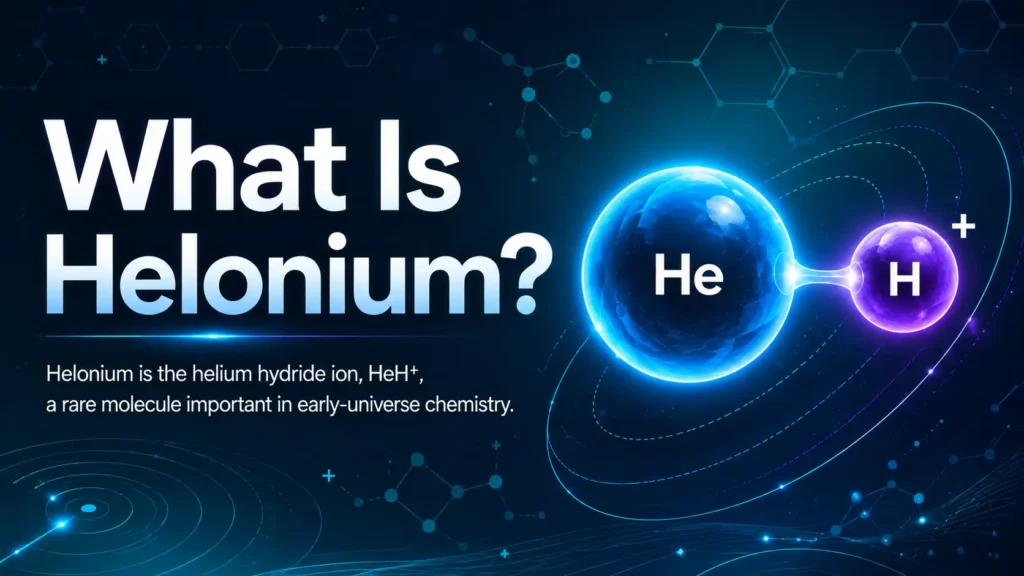
In chemistry, helonium refers to the helium hydride cation, HeH⁺. It contains helium and hydrogen joined together in a positively charged molecular ion.
The easiest way to understand it is to think of helium gaining a proton. For that reason, chemists may describe HeH⁺ as protonated helium.
Read this also: Guess What, Chicken Butt! Meaning, Origin, and How to Use It
Simple Definition of Helonium
Helonium is:
- A molecular ion
- Made from helium and hydrogen
- Positively charged
- Written chemically as HeH⁺
- Better known scientifically as the helium hydride ion
- Important in studies of early cosmic chemistry
NIST identifies HeH⁺ specifically as the helium hydride cation and gives it a charge of +1.
What Is Helonium?
Helonium belongs to a completely different category from ordinary helium.
Helium, symbol He, is an element. Helonium, HeH⁺, contains two nuclei and carries an electrical charge. That makes it a molecular ion rather than an element.
Helonium at a Glance
| Property | Helonium |
| Common scientific name | Helium hydride ion |
| Formula | HeH⁺ |
| Charge | +1 |
| Components | Helium and hydrogen |
| Type | Molecular cation |
| Element? | No |
| Periodic table position | None |
| Laboratory discovery | 1925 |
| Confirmed space detection | 2019 |
| Famous astronomical source | NGC 7027 |
The laboratory history and astronomical detection dates come directly from the research record published with the 2019 discovery.
Is Helonium a Chemical Element?
No. Helonium is not a chemical element.
Chemical elements have defined atomic numbers determined by their proton counts. Hydrogen has atomic number 1 while helium has atomic number 2.
Helonium combines nuclei from both elements. Therefore, it cannot receive a separate atomic number or occupy another box on the periodic table.
This distinction matters because the name sounds element-like. Words such as helium, uranium, and plutonium end similarly. However, the resemblance is linguistic rather than chemical.
Helonium vs. Helium
| Feature | Helonium | Helium |
| Formula | HeH⁺ | He |
| Type | Molecular ion | Chemical element |
| Charge | +1 | Normally neutral |
| Contains hydrogen | Yes | No |
| Atomic number | None | 2 |
| Stable in ordinary bulk form | No | Yes |
| Common practical uses | Research-focused | Numerous |
Helium is an exceptionally unreactive noble gas. Helonium represents a much more reactive ionic form involving helium and hydrogen.
Why Is It Called Helonium?
The word helonium is an alternative name for the helium hydride ion. The systematic name commonly given for the species is hydridohelium(1+).
The “onium” style of naming often appears with positively charged species created through protonation. In practical scientific literature, however, researchers overwhelmingly recognize the formula HeH⁺ and the phrase helium hydride ion.
So, when you encounter “helonium,” don’t imagine another element. Read it as another label for protonated helium.
How Do You Pronounce Helonium?
A practical English pronunciation is:
hee-LOH-nee-um
Pronunciation may vary slightly between speakers because the word appears far less often in everyday conversation than “helium.”
What Is Helonium Made Of?
HeH⁺ is remarkably simple. It contains a helium nucleus and a hydrogen nucleus associated within one molecular ion.
Its simplicity makes it valuable to physicists and chemists. Simple ions let researchers test quantum-mechanical calculations with fewer complications than larger molecules.
The ion is also heteronuclear, meaning its nuclei come from two different elements. That separates it from species such as H₂, where both nuclei belong to hydrogen.
Why Can Helium Form HeH⁺?
Helium has a reputation for refusing to react. That reputation is largely deserved.
A neutral helium atom has a filled electron shell, making ordinary chemical reactions energetically unfavorable. Yet extreme environments can change the picture.
In ionized gases and astrophysical plasmas, charged particles collide under conditions unlike those inside a bottle of helium. Under suitable conditions, a helium atom can associate with a proton and form HeH⁺ while releasing energy as radiation.
The 2019 Nature study describes early-universe formation through radiative association between neutral helium atoms and protons.
How Does Helonium Form?
A simplified picture looks like this:
helium + proton → helium hydride ion + radiation
This process matters because the young universe contained enormous amounts of hydrogen and helium but essentially none of the heavier elements found in modern chemistry.
Formation in the Early Universe
As the universe expanded and cooled, conditions eventually allowed electrons and atomic nuclei to form neutral atoms.
Helium reached a neutral state before much of the hydrogen. Neutral helium could then interact with remaining protons. Those encounters created HeH⁺ through radiative association.
Later reactions involving HeH⁺ helped open chemical pathways toward molecular hydrogen, H₂.
That sequence represents one of chemistry’s earliest chapters.
When Was Helonium Discovered?
Scientists didn’t first encounter HeH⁺ through a telescope.
They produced it experimentally in 1925.
T. R. Hogness and E. G. Lunn detected the ion during experiments involving hydrogen and helium. Their work appears in Physical Review and is cited in the modern astronomical discovery paper as the laboratory discovery of HeH⁺.
That creates an unusual scientific timeline:
- 1925: HeH⁺ identified in laboratory work
- Late 1970s: researchers seriously discussed its possible presence in astrophysical plasmas
- 1980s–2010s: astronomers continued searching for convincing signatures
- 2019: researchers reported an unambiguous astronomical detection
The story shows how proving that something can exist in a laboratory doesn’t automatically prove that nature produces detectable amounts of it elsewhere.
Where Was Helonium Found in Space?
The breakthrough came from NGC 7027, a planetary nebula.
Despite the name, a planetary nebula has nothing to do with planets. It is an expanding shell of gas surrounding a dying star.
Scientists had already considered NGC 7027 a promising target because its physical conditions could support the formation of HeH⁺. Earlier searches had failed to deliver unequivocal evidence.
Then researchers used the airborne Stratospheric Observatory for Infrared Astronomy, or SOFIA, to look at the nebula.
They detected the ground-state rotational transition of HeH⁺ at a wavelength of approximately 149.1 micrometers.
Case Study: The 2019 Detection of HeH⁺
The 2019 discovery provides a perfect example of how theory, laboratory chemistry, and observational astronomy can converge.
For decades, theoretical models said helium hydride should exist in particular cosmic environments. Laboratory spectroscopy told researchers what kind of spectral fingerprint to seek.
The problem was seeing that fingerprint clearly enough.
Earth’s atmosphere blocks or interferes with much of the far-infrared and terahertz radiation astronomers need to study. SOFIA solved part of that problem by carrying a telescope aboard a modified aircraft, allowing observations high above much of the atmosphere.
Using the upGREAT spectrometer onboard SOFIA, researchers observed the J = 1–0 rotational transition of HeH⁺ toward NGC 7027.
The result ended a search that had lasted decades.
NASA later summarized the importance of the result by explaining that helium hydride represents the first type of molecule expected to have formed in the young universe.
Researchers described HeH⁺ as containing the “Universe’s first molecular bond.”
That short phrase captures why such a tiny ion became a major astronomical target.
Helonium and the Chemistry of the Early Universe
After the Big Bang, the universe didn’t immediately contain planets, dust, water, carbon compounds, or complex molecules.
Its chemistry began with a much smaller toolkit dominated by hydrogen and helium.
As temperatures fell, atoms became capable of forming. Once neutral helium encountered protons under suitable conditions, HeH⁺ could emerge.
That makes helium hydride a bridge between atomic matter and molecular chemistry.
HeH⁺ didn’t remain the dominant molecule forever. Continued chemical evolution created routes toward molecular hydrogen. H₂ later became vastly more important in the formation and cooling of cosmic gas.
Still, HeH⁺ occupies the opening pages of that story.
Why Is Helonium Scientifically Important?
Helonium has little everyday usefulness, yet its scientific value is substantial.
It Tests Early-Universe Chemistry
Cosmological chemistry relies on networks of predicted reactions. Detecting HeH⁺ in a real astrophysical environment gives researchers another way to test whether those reaction networks behave as expected.
It Connects Chemistry and Astronomy
Scientists need laboratory measurements to identify molecules in space.
A telescope doesn’t usually photograph an individual HeH⁺ ion. Instead, astronomers study characteristic wavelengths emitted or absorbed when molecules change energy states.
It Shows That Noble Gases Aren’t Completely Inert
Helium is famously reluctant to form ordinary compounds. HeH⁺ demonstrates that unusual conditions can produce meaningful helium chemistry.
It Helps Refine Astrochemical Models
The 2019 observations provided real data that researchers could compare with models of ionized nebular gas.
Chemical and Physical Behavior of Helonium
HeH⁺ behaves nothing like a bottle of helium gas.
It is a charged molecular species that survives under highly specific conditions.
Key Scientific Facts
- Formula: HeH⁺
- Net charge: +1
- Type: molecular cation
- Atoms involved: helium and hydrogen
- Astronomical transition detected: 149.1 micrometers
- Laboratory discovery: 1925
- Space detection: 2019
- Confirmed astronomical target: NGC 7027
NIST’s ion database explicitly lists HeH⁺ as a +1 helium hydride cation.
Because the species is highly reactive, you won’t find cylinders of helonium sitting beside commercial helium tanks. It is mainly studied when it forms in controlled experiments or rare astrophysical environments.
Does Helonium Occur Naturally?
Yes, but not like oxygen, nitrogen, or helium gas around us.
The 2019 observation demonstrated that HeH⁺ forms naturally in an astrophysical environment. Researchers found its spectral signature in NGC 7027.
That doesn’t mean large reservoirs of the ion float through space.
HeH⁺ forms and disappears through ongoing chemical reactions. Its abundance depends heavily on temperature, radiation, ionization, density, and surrounding particles.
On Earth, scientists can create and study the ion under laboratory conditions. Ordinary environments don’t allow large, stable samples to accumulate.
Read this also: Best Reply to “Sup” and Its Meaning: 150+ Smart, Funny & Flirty Responses
What Is Helonium Used For?
You shouldn’t think of HeH⁺ as a commercial material.
Its main “uses” involve scientific investigation.
Astrochemistry
Researchers study HeH⁺ to understand chemical reactions in ionized cosmic gases.
Molecular Spectroscopy
Laboratory measurements of HeH⁺ transitions help astronomers recognize its fingerprint in space.
Cosmology
Models use helium hydride reactions to explore the transition from an almost entirely atomic early universe toward increasingly complex molecular chemistry.
Laboratory Chemistry
Because HeH⁺ is simple, it provides a useful system for studying molecular ions, bonding, spectroscopy, and quantum calculations.
Is Helonium Used in Medicine or Industry?
No established mainstream medical treatment or industrial process depends on bulk helonium.
This is where confusion with helium often causes problems.
Helium itself has numerous practical applications. It can support cryogenic systems, scientific instruments, specialized manufacturing, leak detection, and other technologies.
Those uses belong to helium, not HeH⁺.
Helonium remains primarily a research species.
Helonium vs. Similar Scientific Terms
Several related words sound confusingly alike.
| Term | Meaning |
| Helonium | HeH⁺, helium hydride cation |
| Helium | Element He, atomic number 2 |
| Helium hydride ion | Standard descriptive name for HeH⁺ |
| Hydridohelium(1+) | Systematic name associated with HeH⁺ |
| Helion | Helium nucleus, especially in nuclear-physics terminology |
Checking the formula usually clears up the confusion. If you see HeH⁺, the discussion concerns the helium hydride ion rather than ordinary helium.
Common Misconceptions About Helonium
Myth: Helonium Is a New Element
False. HeH⁺ is a molecular cation containing existing elements.
Myth: Helonium and Helium Are Identical
False. Helium is He. Helonium is HeH⁺.
Myth: Helonium Has an Atomic Number
It doesn’t. Atomic numbers belong to elements.
Myth: Scientists Discovered It in 2019
Not exactly.
Scientists had known HeH⁺ from laboratory work since 1925. The 2019 breakthrough was its astronomical detection.
Myth: Helonium Is Fictional
It is a genuine chemical ion documented experimentally and astronomically.
Myth: Helonium Is a Stable Commercial Gas
No. It is a reactive ion studied under specialized conditions rather than stored like ordinary helium.
Helonium in a Sentence
A few examples make the term easier to use correctly.
Scientific example: Researchers study helonium to understand how simple molecular ions form.
Astronomy example: Astronomers confirmed HeH⁺ in the planetary nebula NGC 7027 in 2019.
Educational example: Helonium should not be confused with helium because one is a molecular ion while the other is an element.
Chemistry example: The formula HeH⁺ represents a positively charged helium-hydrogen species.
Frequently Asked Questions About Helonium Meaning
Helonium commonly refers to the helium hydride ion, HeH⁺. It is a positively charged molecular ion made from helium and hydrogen.
No. Helonium is not an element. It is a molecular ion formed from two existing elements: helium and hydrogen.
The chemical formula is HeH⁺. The plus sign shows that the ion carries a positive electrical charge.
No. Helium is the chemical element He, while helonium refers to HeH⁺, which contains both helium and hydrogen.
Helonium helps scientists study early-universe chemistry and understand how the first simple molecular bonds formed after the universe began cooling.
Scientists identified the helium hydride ion in laboratory experiments in 1925. Astronomers later confirmed its presence in space in 2019.
Scientists detected HeH⁺ in NGC 7027, a planetary nebula located thousands of light-years from Earth.
Yes. It can form naturally under specific astrophysical conditions, although it does not accumulate like ordinary gases on Earth.
Helonium does not have widespread medical or industrial applications. Researchers mainly study it in chemistry, spectroscopy, astronomy, and astrophysics.
The names sound similar, which causes confusion. Helium is a stable noble-gas element, while helonium is a positively charged molecular ion containing helium and hydrogen.
Final Takeaway: What Does Helonium Mean?
Helonium may sound like a new element, yet it actually refers to the helium hydride ion, HeH⁺, in scientific contexts. Understanding the term becomes easier when you look at its formula, chemical structure, origin, and role in early-universe chemistry. It is not the same as helium, has no separate atomic number, and is mainly important in astronomy, spectroscopy, and molecular research. Its scientific value comes from helping researchers understand how some of the earliest molecular bonds formed in space.