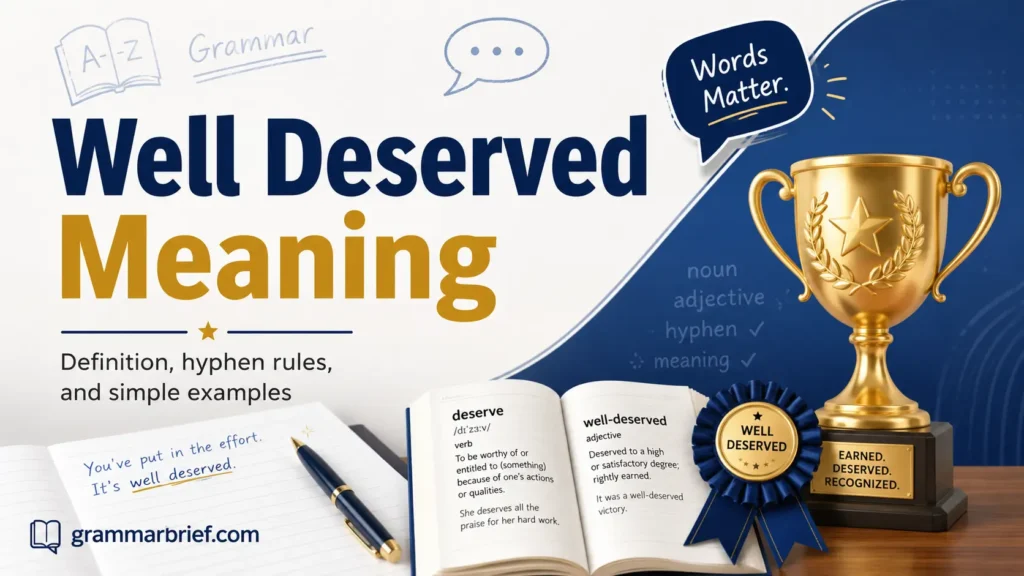

The well deserved meaning is simple: something is rightfully earned or truly justified because of effort, hard work, dedication, or skill. In everyday situations such as school, work, or personal goals, people use well deserved to show appreciation, recognition, respect, and praise. If someone reaches success through real efforts, saying the reward or achievement was well deserved shows that they earned it fairly through true merit.
The main confusion involves grammar, hyphenation, and placement. Use well-deserved before a noun, as in “a well-deserved promotion.” Here, it works as an adjective or modifier. Use well deserved after a linking verb, as in “Her promotion was well deserved.” Both forms are grammatically correct when used in the right place. The form well deserve can also be correct when deserve works as a verb, but it does not replace well deserved.
For clear writing, keep the meaning and usage simple. Before a noun, use the hyphenated form. After a verb, the open form usually sounds more natural, professional, and easy to read.
What Does Well Deserved Mean?
Well deserved means fully earned, justified, or merited.
People often use the phrase when someone’s actions, effort, character, or performance justify a particular outcome.
For example:
After years of excellent work, Maya earned a well-deserved promotion.
In this case, Maya didn’t receive the promotion by chance. Instead, her strong performance gave the company a clear reason to reward her.
People commonly connect the phrase with positive outcomes such as:
- promotions
- awards
- praise
- success
- recognition
- respect
- vacations
- victories
- bonuses
- rest
However, well deserved doesn’t always describe something positive.
For instance, someone can face:
- well-deserved criticism
- a well-deserved penalty
- a well-deserved suspension
- a well-deserved defeat
Therefore, the phrase doesn’t simply mean “good.” It means fair, earned, or justified.
Read this also: Restaurant Guru Meaning: What the Phrase and Website Really Mean
Well Deserved Meaning in Simple Words
In simple English, well deserved means “truly earned.”
Imagine a student who studies every day, completes every assignment, and earns the highest grade in class. You could say:
Her excellent result was well deserved.
Similarly, imagine a runner who trains for months and finally wins a difficult race.
It was a well-deserved victory.
In both examples, effort supports the final result. As a result, the achievement feels fair rather than accidental.
Quick Meaning Guide
| Phrase | Simple Meaning |
| well deserved | Truly or fully earned |
| well-deserved | Describes something someone truly earned |
| deserve | To be worthy of receiving something |
| deserved | Earned or justified |
| well-earned | Earned through clear effort |
Well Deserved or Well-Deserved: Which Is Correct?
Both well deserved and well-deserved can be correct.
The main difference comes from sentence position.
When the phrase appears directly before a noun, write well-deserved:
She took a well-deserved break.
On the other hand, when the phrase follows a linking verb, write well deserved:
Her break was well deserved.
Here’s a quick comparison:
| Form | When to Use It | Example |
| well-deserved | Before a noun | He received a well-deserved award. |
| well deserved | After a linking verb | His award was well deserved. |
| well deserve | When deserve acts as the main verb | They well deserve our support. |
Although the first two forms look different, they carry almost the same meaning. Their position simply changes the punctuation.
When to Use Well-Deserved With a Hyphen
Use well-deserved before a noun.
In this position, well and deserved work together to describe the noun that follows.
Common examples include:
- a well-deserved break
- a well-deserved vacation
- a well-deserved promotion
- a well-deserved victory
- well-deserved praise
- a well-deserved reward
- a well-deserved reputation
For example:
Elena received a well-deserved promotion.
Here, well and deserved work together to describe promotion. Therefore, the hyphen helps readers see that connection immediately.
Grammar guides often call this type of expression a compound modifier.
Still, you don’t need to remember the technical term. Instead, keep one practical rule in mind:
If “well deserved” comes directly before a noun, add the hyphen.
When to Use Well Deserved Without a Hyphen
Writers usually leave out the hyphen when well deserved comes after a linking verb.
For example:
- Her promotion was well deserved.
- Their victory was well deserved.
- The praise seems well deserved.
- His reputation is well deserved.
- The criticism felt well deserved.
Common linking verbs include:
- is
- are
- was
- were
- seems
- appears
- feels
Now compare these two sentences:
She received a well-deserved award.
Her award was well deserved.
The meaning stays almost the same. However, the position of the phrase changes.
Is Well Deserved Grammatically Correct?
Yes. Well deserved is grammatically correct.
For example:
The recognition was well deserved.
Their success is well deserved.
Her reputation seems well deserved.
Meanwhile, the hyphenated form works before a noun:
She received well-deserved recognition.
So, instead of asking which form is always correct, check the phrase’s position in the sentence.
Is Well Deserved an Adjective?
In many sentences, well deserved works like an adjective because it describes a person, result, thing, or outcome.
Compare these examples:
They enjoyed a well-deserved holiday.
The holiday was well deserved.
In the first sentence, well-deserved directly describes holiday. In the second sentence, well deserved describes the holiday after the verb was.
This distinction also clears up a common grammar mistake. Well-deserved normally doesn’t work as a noun.
For instance, this sentence sounds incomplete:
She received a well-deserved.
Instead, add a noun:
She received a well-deserved reward.
What Does Deserved Mean?
The word deserved comes from the verb deserve.
To deserve something means that your actions, qualities, behavior, or circumstances make you worthy of receiving it.
For example:
You deserve some rest.
She deserved the award.
His performance deserved praise.
Adding well strengthens the idea.
Compare:
His recognition was deserved.
with:
His recognition was well deserved.
The second sentence gives stronger approval. In other words, the speaker believes the person clearly earned the recognition.
Well Deserved vs. Well Deserve
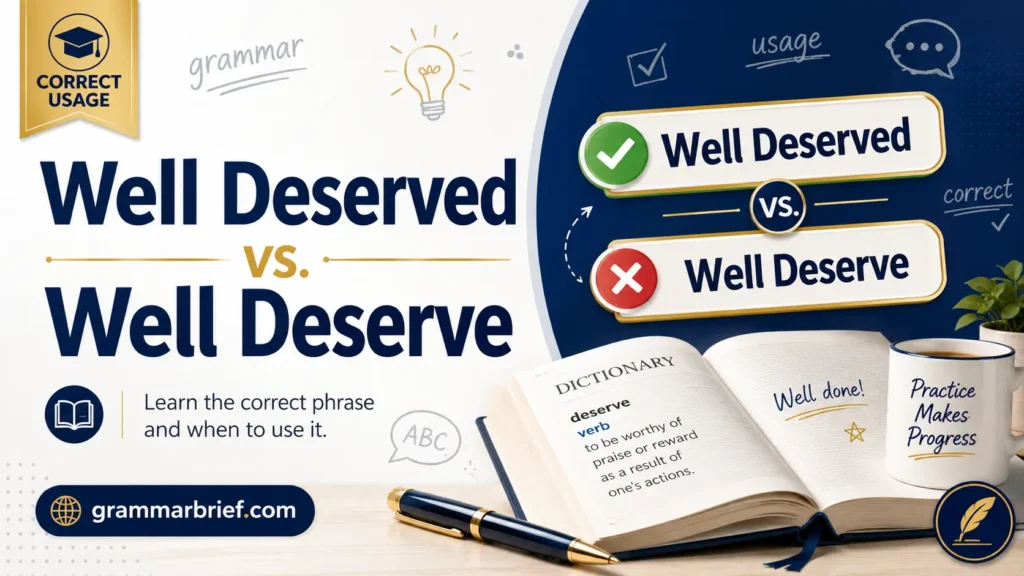
Well deserved and well deserve don’t mean exactly the same thing.
Consider these examples:
Your promotion was well deserved.
You deserve your promotion.
However, this sentence sounds wrong:
Your promotion was well deserve.
The correct version is:
Your promotion was well deserved.
The word deserve works as a verb. By contrast, deserved can work as the past form of that verb or as part of an adjective phrase.
Can Well Deserve Ever Be Correct?
Yes.
For example:
They well deserve our respect.
Here, deserve acts as the main verb, while well adds emphasis.
The sentence means:
They truly deserve our respect.
However, this structure can sound formal. In everyday conversation, most people would probably say:
They really deserve our respect.
So, well deserve isn’t always wrong. It simply follows a different grammar pattern.
Examples of Well Deserved in Sentences
Real examples make the distinction easier to remember.
Achievement and Success
- Her scholarship was well deserved.
- Daniel celebrated a well-deserved promotion.
- The team earned a well-deserved victory.
- Her academic success was well deserved.
- The award brought him well-deserved recognition.
Praise and Recognition
- The volunteers received well-deserved praise.
- His reputation for honesty is well deserved.
- The singer earned a well-deserved standing ovation.
- Their excellent work attracted well-deserved attention.
- The teacher’s recognition was well deserved.
Rest and Relaxation
- You need a well-deserved break.
- She enjoyed a well-deserved vacation.
- After finishing the project, the team took a well-deserved rest.
- He finally enjoyed some well-deserved time off.
- The holiday felt well deserved after such a busy year.
Negative Consequences
The phrase can also describe negative results.
For example:
- The player received a well-deserved suspension.
- The company faced well-deserved criticism.
- His penalty seemed well deserved.
- The team suffered a well-deserved defeat.
- The dishonest claim caused well-deserved backlash.
Therefore, remember one important point: deserved doesn’t mean pleasant. It means justified.
Common Phrases With Well Deserved
People use some combinations more often than others.
| Common Phrase | Meaning | Example |
| well-deserved break | Rest earned after effort | Take a well-deserved break. |
| well-deserved rest | Rest after hard work | She enjoyed a well-deserved rest. |
| well-deserved promotion | Career progress someone earned | His promotion was well deserved. |
| well-deserved success | Success based on effort or merit | Their success is well deserved. |
| well-deserved praise | Praise someone genuinely earned | The staff received well-deserved praise. |
| well-deserved victory | A victory someone fairly earned | It was a well-deserved victory. |
| well-deserved recognition | Fair acknowledgment | Her work earned well-deserved recognition. |
| well-deserved reputation | A reputation supported by actions | The hotel has a well-deserved reputation for service. |
What Does Well-Deserved Success Mean?
Well-deserved success means success that someone earned through effort, skill, persistence, talent, or good decisions.
For example, imagine a business owner who spends years improving customer service, product quality, and staff training. Eventually, customers notice the difference and the business grows.
You could say:
Their success is well deserved.
Of course, luck can still play a role. Success often depends on effort, timing, opportunity, resources, and chance.
Still, well deserved tells readers that strong reasons support the success.
What Does More Than Well Deserved Mean?
More than well deserved adds extra emphasis.
People often use it when someone earned something so clearly that deserved alone feels too weak.
For example:
After twenty years of excellent service, her award was more than well deserved.
Likewise, you could say:
- Your promotion is more than well deserved.
- That recognition was more than well deserved.
- Their victory was more than well deserved.
As a result, the phrase often sounds warm and supportive.
Is Well Deserved a Compliment?
Usually, yes.
When you tell someone that an achievement was well deserved, you recognize the effort or ability behind it.
Imagine a coworker says:
“I finally got promoted.”
You might reply:
“Congratulations! That’s well deserved.”
Your response does more than celebrate the news. It also tells your coworker that you believe they earned the promotion.
However, context can change the tone.
Compare:
Your award was well deserved.
with:
The criticism was well deserved.
The first sentence offers praise. The second expresses judgment.
So, well deserved can work as a compliment, but its basic meaning remains “earned or justified.”
Can You Say “Well Deserved!” by Itself?
Yes.
“Well deserved!” works naturally as a short response.
For example:
“I finally passed my certification exam!”
“Well deserved!”
People often use this short expression in:
- text messages
- social media comments
- workplace chats
- congratulatory messages
- casual conversations
Because the context already explains the achievement, you don’t need a complete sentence.
In other words, “Well deserved!” can simply mean:
“You truly earned that achievement.”
Is “Congratulations, Well Deserved” Correct?
People will understand “Congratulations, well deserved,” but stronger punctuation sounds more natural.
For example:
Congratulations! Well deserved!
You can also write:
- Congratulations on your well-deserved promotion.
- Congratulations! You truly earned it.
- Your success is well deserved. Congratulations!
- Congratulations on this well-deserved achievement.
For social media, “Congratulations! Well deserved!” sounds friendly and natural.
For professional messages, however, a complete sentence usually sounds more polished.
Read this also: Goomar Meaning: Definition, Origin, Pronunciation, and Usage
How to Say Well Deserved to Someone
Your wording can change with the situation.
Professional Examples
- Your promotion is well deserved.
- Congratulations on this well-deserved recognition.
- Your hard work clearly paid off.
- This achievement reflects the quality of your work.
- Congratulations on a truly well-deserved award.
Friendly Examples
- You earned it!
- So well deserved!
- All that hard work paid off.
- Couldn’t be happier for you.
- You absolutely deserve this.
Warm and Enthusiastic Examples
- No one deserves this more than you.
- You’ve worked incredibly hard for this.
- What a well-deserved achievement!
- This couldn’t have happened to a more deserving person.
Synonyms for Well Deserved
You don’t need to repeat well deserved in every sentence.
Instead, choose an alternative that fits the context.
| Alternative | Best Use | Example |
| earned | General achievements | She earned the recognition. |
| merited | Formal contexts | His praise was fully merited. |
| justified | Decisions or consequences | The criticism was justified. |
| rightful | Something properly belonging to someone | She received her rightful reward. |
| fitting | Suitable results or tributes | It was a fitting tribute. |
| well-earned | Effort-focused situations | He took a well-earned break. |
| richly deserved | Strong praise | The applause was richly deserved. |
| appropriate | Neutral judgments | The penalty seemed appropriate. |
Therefore, the best synonym depends on what you want to emphasize.
Well Deserved vs. Well Earned
Well deserved and well earned have similar meanings. However, each phrase can emphasize something slightly different.
Well earned often focuses on effort.
After working all weekend, she took a well-earned break.
By contrast, well deserved focuses more on merit or fairness.
Her promotion was well deserved.
Compare:
a well-earned victory
and:
a well-deserved victory
Both sound natural. Still, well earned highlights the effort behind the result, while well deserved highlights whether the result feels fair.
Related Expressions and Idioms
English offers several expressions with similar ideas.
Richly Deserved
Richly deserved adds stronger emphasis.
The scientist received richly deserved recognition.
Give Credit Where Credit Is Due
This expression means recognizing someone’s contribution fairly.
Give credit where credit is due. Jordan solved the problem.
Reap What You Sow
This idiom means your actions can create matching results later.
He ignored every warning and eventually reaped what he had sown.
Get What You Deserve
This phrase can describe either a reward or a consequence.
After years of hard work, she finally got what she deserved.
Just Deserts
Just deserts means the reward or punishment that someone’s behavior earns.
People often confuse it with just desserts. However, the traditional expression uses deserts.
Fair and Square
Fair and square means honestly and according to the rules.
They won the competition fair and square.
Although it doesn’t mean exactly the same thing as well deserved, both expressions can describe fair success.
Common Mistakes to Avoid
A few simple mistakes create most of the confusion.
Writing “Well Deserve” After a Linking Verb
Incorrect:
The award was well deserve.
Correct:
The award was well deserved.
Forgetting the Hyphen Before a Noun
Less clear:
She took a well deserved break.
Preferred:
She took a well-deserved break.
Adding a Hyphen Everywhere
Don’t force the hyphen into every sentence.
For example:
She received a well-deserved promotion.
However:
Her promotion was well deserved.
Assuming It Only Describes Positive Things
Negative consequences can also be well deserved.
For instance:
The player received a well-deserved penalty.
Treating Well-Deserved as a Noun
Incorrect:
He finally received a well-deserved.
Correct:
He finally received a well-deserved reward.
Well Deserved in American and British English
American and British English speakers use well deserved with the same basic meaning.
In both varieties, the phrase can describe rewards, success, recognition, praise, consequences, and other outcomes that someone genuinely earns.
However, individual publishers may follow slightly different hyphenation preferences.
For everyday writing, this pattern works well:
- Before a noun: well-deserved
- After a linking verb: well deserved
Above all, keep your style clear and consistent.
Easy Trick to Remember Well Deserved vs. Well-Deserved
Use this simple memory trick:
Before the noun, join the words. After the verb, let them separate.
For example:
She took a well-deserved break.
Then compare:
Her break was well deserved.
Likewise:
It was a well-deserved victory.
But:
Their victory was well deserved.
Once you remember this pattern, the hyphen becomes much easier to handle.
Read this also: Sniffies Meaning: What It Means, How It’s Used, and Where It Came From
Well Deserved Meaning: Quick Summary
The well deserved meaning centers on something that a person genuinely earns, merits, or deserves.
In short:
- Well deserved means fully earned or justified.
- Use well-deserved before a noun.
- Use well deserved after a linking verb in most everyday writing.
- Well deserve can work when deserve acts as the main verb.
- The phrase can describe positive and negative outcomes.
- Well-earned often puts more emphasis on effort.
Frequently Asked Questions
Well deserved means truly earned or justified. It shows that someone received a reward, praise, success, or result because of genuine effort or merit.
Yes. Well deserved is grammatically correct, especially when it comes after a linking verb, such as in “Her success was well deserved.”
Both are correct. Use well-deserved before a noun and well deserved after a linking verb.
Use a hyphen when the phrase directly describes a noun, such as “a well-deserved break.” After a linking verb, the hyphen is usually unnecessary.
A simple example is: “She received a well-deserved promotion after years of hard work.”
Yes. “Well deserved!” is a natural short response when congratulating someone on an achievement or success.
Usually, yes. It tells someone that you believe they genuinely earned their success, praise, award, or recognition.
Common alternatives include earned, merited, justified, rightful, fitting, well-earned, and richly deserved.
Common alternatives include earned, merited, justified, rightful, fitting, well-earned, and richly deserved.
Yes. A punishment, penalty, criticism, or defeat can also be well deserved when the circumstances clearly justify it.
Final Thoughts
Well Deserved Meaning: Definition, Hyphen Rules, and Examples explains how the phrase shows something truly earned or justified. In everyday English, well deserved expresses appreciation, recognition, respect, and praise for effort, hard work, dedication, skill, or achievement. A reward, success, or result may be rightfully earned because someone has shown true merit.
The main confusion comes from grammar, hyphenation, and placement. Use well-deserved before a noun, where it works as an adjective or modifier, as in “a well-deserved promotion.” Use well deserved after a linking verb, as in “The promotion was well deserved.” Both forms are grammatically correct when used properly. Understanding the difference, rules, and usage helps you write in a natural, professional, precise, and easy-to-read way.