
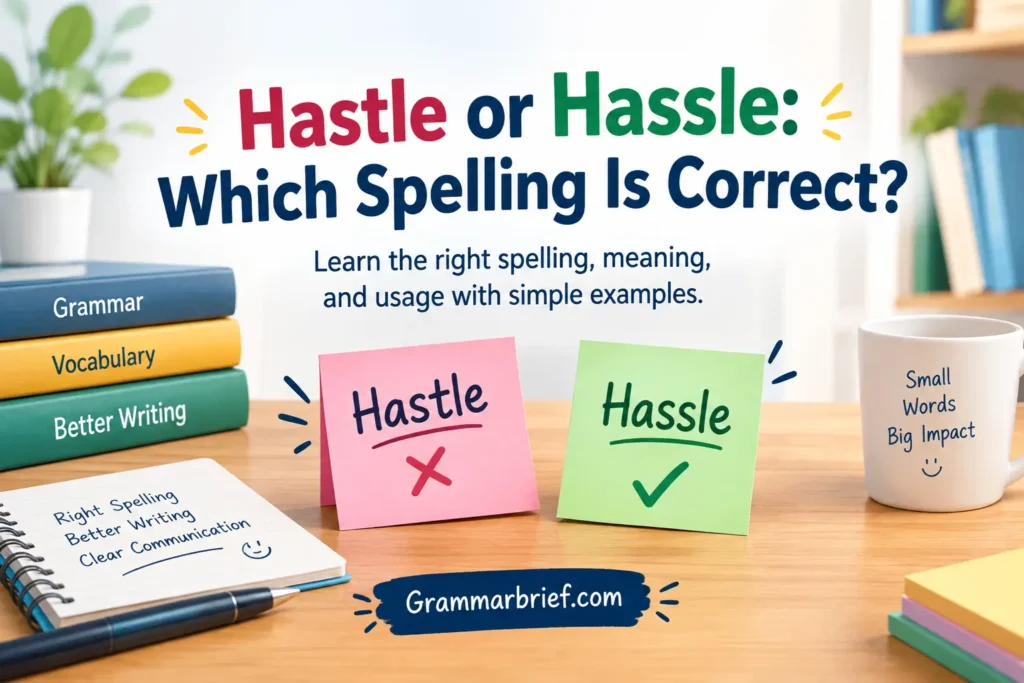

Hastle or Hassle: Which Spelling Is Correct? is a common question for English learners and native speakers. A common spelling mistake can cause confusion, especially in texts, emails, homework, and social media. The correct word is hassle, meaning trouble, annoyance, stress, or problems that make something harder. The right spelling improves spelling accuracy, writing confidence, and communication skills. Hastle is the wrong form and a misspelling.
The correct spelling appears in an English dictionary and standard English dictionaries covering British English, American English, and Australian English. Hassle can work as a noun or verb and has a clear pronunciation, meaning, word origin, and normal usage. Similar-looking words like castle and hustle may create spelling confusion, especially during fast typing, fast texting, or when words are spoken quickly.
These mistakes can appear in professional emails, published blog posts, professional documents, and academic assignments. Simple memory tricks, grammar rules, and practical examples can help you remember the correct meaning and avoid future typing mistakes. With regular practice, choosing hassle becomes automatic.
Hastle or Hassle: The Quick Answer
Here’s the simplest way to remember the difference:
| Spelling | Correct standard English? | Meaning |
| Hassle | Yes | An annoying difficulty, inconvenience, or trouble |
| Hastle | No, generally | Common misspelling of “hassle” |
| Hustle | Yes, but different word | Energetic activity, movement, effort, or other meanings |
So if you want to say that something is annoying or inconvenient, use hassle.
For example:
“Finding a parking space was a hassle.”
Not:
“Finding a parking space was a hastle.”
The extra s matters. The correct spelling is H-A-S-S-L-E.
Read this also: White Heart Emoji Meaning : What It Means in Texting, Love & Social Media
What Does “Hassle” Mean?
Hassle refers to a difficulty, inconvenience, annoyance, or troublesome situation. It often describes something that isn’t necessarily disastrous but takes more time, effort, patience, or energy than you want to spend.
For example, changing a bank account might involve several forms, phone calls, identification checks, and waiting. You might simply say:
“Changing the account was such a hassle.”
That sentence doesn’t necessarily mean the process was impossible. It means the process was annoying, inconvenient, or unnecessarily difficult.
Cambridge defines hassle as difficulty or trouble, or a situation that causes it. Oxford similarly describes it as an annoying situation involving something difficult or complicated that requires considerable effort.
Hassle as a Noun
As a noun, hassle describes the problem or difficult situation itself.
Common examples include:
- “Parking downtown is a hassle.”
- “The paperwork was a huge hassle.”
- “I don’t want the hassle of moving.”
- “Traveling with three children can be a hassle.”
- “It wasn’t worth all the hassle.”
The noun can be countable or uncountable, depending on how it’s used. You can talk about a hassle or several hassles, while expressions such as all the hassle treat it more generally.
Hassle as a Verb
As a verb, hassle means to annoy, bother, or cause someone trouble. It often involves repeated requests, pressure, complaints, or unwanted attention.
For example:
- “Stop hassling me about the deadline.”
- “The salesperson kept hassling us to buy something.”
- “My brother has been hassling me for money.”
- “Customers shouldn’t have to be hassled repeatedly.”
Oxford specifically describes the verb as causing someone trouble or annoyance, particularly by repeatedly asking them to do something.
This gives hassle two closely related ideas:
Noun: the annoying situation.
Verb: the action of causing that annoyance.
How Do You Spell “Hassle”?
The correct spelling is:
H-A-S-S-L-E
The easiest part to remember is the double S in the middle.
Break it visually into:
HAS + SLE
The incorrect form hastle replaces the second s with t.
That mistake is understandable because English spelling doesn’t always follow pronunciation perfectly. The final part of hassle is pronounced weakly, so a writer who has mainly heard the word may not immediately know which letters belong in the middle.
A useful spelling check is simple:
If you mean an annoying difficulty, spell it HASSLE.
How Is “Hassle” Pronounced?
In standard English pronunciation, hassle is pronounced approximately like:
HAS-uhl
Its dictionary pronunciation is represented as /ˈhæsl/. Cambridge gives essentially the same pronunciation for both American and British English.
The pronunciation helps explain why spelling can cause confusion. The middle letters aren’t pronounced as clearly as they appear when written.
That’s why someone might hear hassle and mentally reconstruct it as hastle.
However, pronunciation shouldn’t change the spelling. The standard written form remains hassle.
Why Do People Spell “Hassle” as “Hastle”?
The mistake usually comes from ordinary spelling uncertainty rather than a meaningful difference between the two words.
Similar Letter Patterns
English contains many words where sounds don’t map neatly to letters. When people write quickly, they may choose a familiar letter pattern that seems to fit the sound.
The -stle pattern appears in words such as castle and whistle. That can make hastle look visually plausible even though it isn’t the standard spelling of hassle.
Pronunciation Confusion
Because the second syllable is weak, speakers may not consciously hear every letter represented in the spelling.
A person may know exactly what hassle means while still being uncertain about how to spell it.
Typing and Memory Errors
Fast typing creates another simple explanation. When someone knows the word but doesn’t regularly write it, the brain can supply an incorrect letter automatically.
Similar errors happen with many English words. Knowing the meaning doesn’t always guarantee accurate spelling.
Confusion With “Hustle”
The word hustle is another likely source of confusion.
Hustle is correctly spelled with u, while hassle uses a and has a double s.
Because both words end in -stle/-ssle-like sounds when spoken quickly, learners sometimes mix their spelling patterns.
Hassle vs. Hustle: What’s the Difference?
Hassle and hustle are completely different words.
| Word | Meaning | Example |
| Hassle | An annoyance, inconvenience, or difficulty | “Getting a refund was a hassle.” |
| Hustle | Energetic movement, activity, effort, or other context-specific meanings | “We need to hustle if we’re going to catch the bus.” |
Think of hassle as something that creates trouble.
Think of hustle as something involving movement, urgency, or energetic effort.
For example:
“The airport security process was a hassle.”
This means the process was inconvenient.
“We had to hustle through the airport.”
This means we had to move quickly or act with urgency.
They aren’t interchangeable.
Common Ways to Use “Hassle” in a Sentence
“Hassle” as a Noun
Here are natural examples:
- “Finding affordable housing can be a hassle.”
- “The return process was a hassle.”
- “I don’t want the hassle of cooking tonight.”
- “Dealing with that paperwork is such a hassle.”
- “The trip was enjoyable despite a few hassles.”
The noun often appears with words such as big, major, unnecessary, legal, daily, and constant.
Examples include:
- a major hassle
- a legal hassle
- a daily hassle
- an unnecessary hassle
- constant hassles
Oxford lists common combinations such as legal hassles, get hassle, give somebody hassle, and take the hassle out of something.
“Hassle” as a Verb
The verb normally takes an object when you mean bothering someone.
Examples:
- “Please don’t hassle me while I’m working.”
- “They kept hassling him about the payment.”
- “The children were hassling their parents for another toy.”
- “Customers shouldn’t be hassled into buying unnecessary products.”
The forms are:
| Form | Example |
| Base | hassle |
| Third person | hassles |
| Past | hassled |
| Present participle | hassling |
Oxford lists hassled as the past form and hassling as the -ing form.
“Hassle-Free”
Hassle-free means something can be done with little or no inconvenience, difficulty, or annoyance.
Examples:
- “The service offers hassle-free returns.”
- “We wanted a hassle-free way to book the trip.”
- “The installation was quick and hassle-free.”
- “Online payment makes the process more hassle-free.”
The expression is especially common in advertising and customer-service language because it promises convenience.
Common Expressions and Collocations With “Hassle”
Some combinations with hassle appear frequently in everyday English.
A hassle
“Getting there without a car is a hassle.”
A lot of hassle
“The old system created a lot of hassle.”
The hassle of
“I don’t want the hassle of changing providers.”
No hassle
“You can cancel with no hassle.”
Without the hassle
“The service lets you shop online without the hassle of visiting a store.”
Hassle-free
“They promise hassle-free returns.”
Hassle someone
“Don’t hassle your sister about it.”
Take the hassle out of something
“The new system takes the hassle out of scheduling appointments.”
These patterns matter because learning collocations can make your English sound more natural than simply memorizing a dictionary definition.
Hassle in Everyday, Professional, and Casual English
Everyday Conversation
Hassle is particularly natural in casual conversations.
You might use it when talking about:
- traffic
- parking
- shopping
- travel
- repairs
- paperwork
- moving
- appointments
- customer service
- household chores
For example:
“I would take the train, but dealing with the transfers is too much hassle.”
This sounds natural because hassle is an informal everyday word.
Professional Communication
You can use hassle in workplace conversation, especially when speaking with colleagues.
For example:
“The current process creates unnecessary hassle for customers.”
However, formal reports may benefit from more precise words such as inconvenience, complication, administrative burden, or difficulty.
Compare:
Casual:
“The approval process is a hassle.”
More formal:
“The approval process creates unnecessary administrative difficulty.”
Neither is grammatically wrong. The second simply has a more formal tone.
Texting and Social Media
Hassle works naturally in informal digital communication.
Examples:
- “Ugh, what a hassle.”
- “Don’t worry about it. No hassle.”
- “Parking there is such a hassle.”
- “I don’t want the hassle today.”
Its short, conversational character makes it well suited to texting and casual posts.
Is “Hassle” Formal or Informal?
Hassle is a standard English word, but dictionaries generally label it informal.
That distinction is useful.
It doesn’t mean the word is incorrect or poor English. It simply means that some formal situations may call for a more neutral alternative.
Depending on the context, alternatives include:
- inconvenience
- difficulty
- problem
- complication
- burden
- annoyance
- obstacle
For everyday speech, hassle is often the most natural choice.
The Origin and Etymology of “Hassle”
The history of hassle is more complicated than its modern meaning suggests.
Etymological sources don’t give one completely certain origin. Etymonline records hassle as an American English noun meaning “fuss” or “trouble” from the mid-20th century and notes possible connections with earlier dialectal forms.
Oxford gives a somewhat different historical account. It traces an earlier dialectal use from the late 19th century meaning roughly “hack or saw at” and says the ultimate origin is uncertain. It also suggests that hassle may have developed from a blend involving haggle and tussle.
The important point is that the exact etymology isn’t settled.
What is clear is that the modern noun developed around ideas of trouble, argument, difficulty, and annoyance, while the verb later developed from the noun. Etymonline dates the modern verb to the early 1950s.
Hassle vs. Trouble vs. Problem vs. Inconvenience
These words overlap, but they’re not identical.
| Word | Main idea | Tone |
| Hassle | Annoying difficulty or inconvenience | Informal |
| Trouble | Difficulty, distress, or a problem | Neutral |
| Problem | Something that needs to be solved | Neutral |
| Inconvenience | Something that disrupts comfort or convenience | More formal |
Consider this example:
“Finding parking was a hassle.”
The speaker emphasizes annoyance and inconvenience.
“Finding parking was a problem.”
This sounds broader and more serious.
“Finding parking was an inconvenience.”
This sounds more formal and restrained.
Choosing the right word depends on the tone and emphasis, not simply the dictionary definition.
Read this also: To Short or Too Short? Grammar Explained With Examples
Common Mistakes With “Hassle”
The spelling hastle is the biggest mistake connected with this word, but it isn’t the only one.
Mistake: Writing “Hastle”
Incorrect:
“The paperwork was a hastle.”
Correct:
“The paperwork was a hassle.”
Mistake: Confusing “Hassle” With “Hustle”
Incorrect word choice:
“The paperwork was such a hustle.”
If you mean annoying difficulty, use hassle.
Mistake: Misspelling “Hassling”
The correct form is:
hassling
Not:
hasseling
The spelling keeps the double s and drops the final e before adding -ing.
Mistake: Using “Hassle” in Highly Formal Writing
The word isn’t wrong, but a formal document may benefit from a more precise term.
For example, instead of:
“This process causes customers a lot of hassle.”
A formal report might say:
“This process creates unnecessary inconvenience for customers.”
How to Remember the Correct Spelling of “Hassle”
The simplest memory trick is to focus on the double S.
Remember the Double S
Think:
HA + SS + LE = HASSLE
The middle SS is the spelling feature that separates hassle from the common misspelling hastle.
Connect Hassle With Stress
A useful memory association is:
Less hassle = less stress.
This isn’t the historical origin of the word. It’s simply a spelling aid.
Learn It in a Sentence
Instead of memorizing the letters alone, remember a natural sentence:
“I don’t need the hassle.”
The more often you see and use the correct form, the easier it becomes to recognize.
Is “Hastle” Ever Correct?
For normal English usage, hastle is not the standard spelling of the word meaning an annoyance, difficulty, or inconvenience.
If you’re writing a sentence about trouble or inconvenience, use hassle.
A particular spelling such as Hastle could potentially appear as a proper name, username, title, or other special designation. That doesn’t make it an alternative spelling of the ordinary English word hassle.
For standard writing, the choice is straightforward:
Use hassle.
Practical Examples of “Hassle” in Real Situations
Travel
“Checking in at the airport was a hassle because the system was down.”
The word emphasizes inconvenience rather than danger.
Customer Service
“Getting a refund became a major hassle.”
The speaker is highlighting the effort and frustration involved.
Workplace
“The outdated software creates unnecessary hassle for employees.”
Here, hassle describes repeated inconvenience caused by a process.
Everyday Life
“Finding a parking spot downtown is always a hassle.”
This is a classic conversational use of the word.
Hassle Synonyms and Antonyms
Synonyms
Depending on context, possible alternatives include:
- inconvenience
- annoyance
- trouble
- difficulty
- bother
- nuisance
- complication
- aggravation
The best synonym depends on what you want to emphasize.
Bother often focuses on annoyance.
Inconvenience emphasizes disruption.
Complication suggests that something has become more difficult than expected.
Nuisance describes something irritating or troublesome.
Antonyms
Useful opposites include:
- ease
- convenience
- simplicity
- comfort
- smoothness
For example:
“The online system makes the process simple and hassle-free.”
Quick Reference: Hastle or Hassle
| Question | Answer |
| Correct spelling? | Hassle |
| Is “hastle” standard? | No |
| Part of speech | Noun and verb |
| Pronunciation | HAS-uhl |
| Noun meaning | Annoying difficulty, trouble, or inconvenience |
| Verb meaning | To annoy, bother, or pressure someone |
| Common phrase | Hassle-free |
| Past tense | Hassled |
| -ing form | Hassling |
| Related but different word | Hustle |
| Style | Generally informal |
Frequently Asked Questions About Hastle or Hassle
No. Hastle is generally a misspelling. The correct spelling is hassle.
Hassle means trouble, difficulty, annoyance, or something that requires unwanted effort.
Hassle can be both a noun and a verb depending on how it’s used in a sentence.
Hassle is pronounced roughly like “HAS-uhl.”
Hassle can be both a noun and a verb depending on how it’s used in a sentence.
Yes. Hassle is commonly used in American English and standard English.
“Getting a refund was a real hassle.”
Hassle is common in everyday English and is generally considered informal.
The plural form is hassles.
Both can describe difficulties. Hassle often suggests inconvenience, effort, or annoyance while trouble has a broader meaning.
Conclusion: Hassle Is the Correct Spelling
When choosing between hastle and hassle, the correct spelling is hassle. It can describe trouble, annoyance, or an inconvenient situation, and it can also work as a verb. Although hastle appears in texts, emails, and casual writing, it’s a misspelling. Remembering the correct form can improve your spelling accuracy and writing confidence. Whenever you’re unsure, choose hassle.