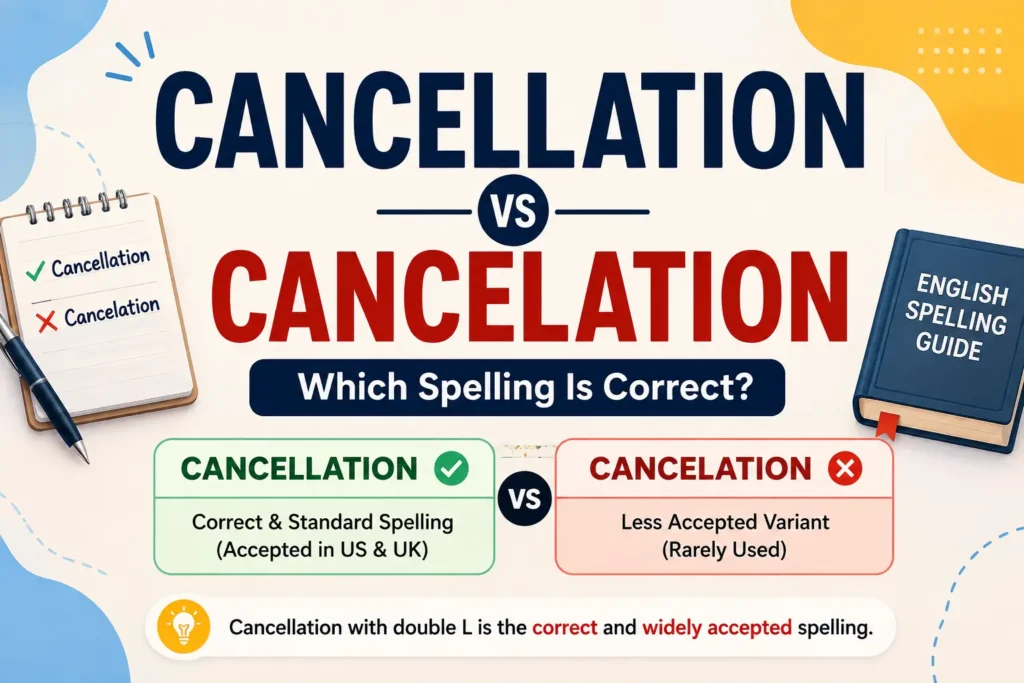

Cancellation vs Cancelation is a common spelling question that causes spelling confusion for students, writers, and everyday English users. Both spellings have the same meaning and describe the act of stopping or ending something that was planned. However, cancellation with a double L is the correct spelling, standard spelling, and most widely accepted form. Cancelation with one L exists as a rare variant, but it is less accepted in modern formal writing.
In both American English and British English, cancellation is the safest spelling choice. Although American spelling often uses “canceled” with one L, the noun normally keeps the double-L spelling. British spelling also uses “cancellation.” This makes the form suitable for professional writing, formal documents, writing emails, articles, and general English usage.
For better spelling accuracy, writing clarity, and spelling consistency, use cancellation as your preferred form. You may see cancelation in books, online tools, or older sources, but cancellation remains the standard form and best choice for clear and correct writing.
Quick Answer: Cancellation or Cancelation?
Use cancellation in almost every situation.
It is the established spelling of the noun in both American and British English. You can safely use it in:
- Business emails
- Academic papers
- Contracts
- Customer service messages
- Travel policies
- Subscription notices
- News writing
- Website copy
- Formal documents
Cancelation isn’t imaginary. Some dictionaries recognize it as a less common variant. Still, most writers, editors, and readers expect cancellation.
A simple rule works well:
When you need the noun, write cancellation.
That choice will rarely cause trouble.
Read this also: Pre vs Post: Meaning, Difference, Usage & Examples
Cancellation and Cancelation at a Glance
The two spellings differ in appearance, not meaning.
| Feature | Cancellation | Cancelation |
| Meaning | The act or result of canceling | Same meaning |
| Spelling | Double L | Single L |
| US English | Standard and preferred | Rare variant |
| British English | Standard | Very uncommon |
| Formal writing | Recommended | Usually avoided |
| Business writing | Recommended | Often looks inconsistent |
| Pronunciation | Same | Same |
| Reader familiarity | Very high | Low |
The key point is simple: cancellation has wider acceptance and stronger modern usage.
What Does Cancellation Mean?
Cancellation is a noun formed from the verb cancel.
It usually describes the act of stopping, ending, withdrawing, or calling off something that had already been planned or arranged.
For example:
- The airline announced a flight cancellation.
- She requested a subscription cancellation.
- The storm caused the event cancellation.
- The company confirmed the order cancellation by email.
The word can also describe an opening created when another person cancels something.
For example:
“The dentist had a cancellation this afternoon, so I got an earlier appointment.”
In that sentence, cancellation refers to an appointment slot that became available.
Common Uses of Cancellation
You’ll regularly see the word in these contexts:
- Travel: flight cancellation, booking cancellation, hotel cancellation
- Business: contract cancellation, meeting cancellation, order cancellation
- Subscriptions: membership cancellation, service cancellation
- Healthcare: appointment cancellation
- Events: concert cancellation, class cancellation
- Insurance: policy cancellation
- E-commerce: purchase cancellation, refund and cancellation policy
Although the setting changes, the basic meaning stays the same.
Is Cancelation a Real Word?
Yes. Cancelation is a real spelling variant.
That doesn’t mean it carries the same level of usage as cancellation.
Dictionaries often record words that appear in real language, including uncommon, regional, historical, or alternative forms. A dictionary entry doesn’t automatically mean every listed variation is equally common or equally suitable in all contexts.
That distinction matters here.
Cancellation is the mainstream spelling. Cancelation exists, particularly in American lexicography, but most modern readers see it far less often.
Think of it like an alternate road that still reaches the destination. It exists, but almost everyone takes the main highway.
Why Cancelation Often Looks Wrong
Many readers have spent years seeing phrases such as:
- Cancellation fee
- Cancellation notice
- Cancellation policy
- Cancellation deadline
- Cancellation request
Because the double-L form dominates familiar phrases, the single-L version can immediately look unusual.
That visual familiarity plays a huge role in spelling.
A technically recognized variant can still distract readers. In professional writing, distraction usually isn’t worth the risk.
Why Does Cancellation Have Two Ls?
This question causes most of the confusion.
At first glance, American writers may reason like this:
cancel → canceled → canceling → cancelation
That pattern seems logical. English, however, doesn’t always develop through perfectly consistent modern rules.
The spelling cancellation has historical roots. English inherited forms related to the Latin word family behind cancel. Over time, the noun became firmly established with a doubled L.
That historical spelling survived even as American English simplified some related verb forms.
So modern American English often gives us this set:
- cancel
- canceled
- canceling
- cancellation
It looks irregular. It is still standard.
The History Behind Cancel
The English verb cancel ultimately traces back to Latin cancellare.
The older meaning involved crossing something out with intersecting lines. Imagine drawing a lattice or crossed pattern over written text so it could no longer stand as valid.
That idea gradually developed into the modern meaning:
to make something no longer valid, active, scheduled, or effective.
Today, you can cancel:
- A contract
- A meeting
- A reservation
- A flight
- A subscription
- A payment
- An event
The spelling history behind cancellation helps explain why it doesn’t behave exactly like simplified American forms such as canceled.
Why You Shouldn’t Treat It as a Simple Suffix Rule
A common mistake is assuming that English always builds a noun by attaching -ation directly to the visible base verb.
That approach would produce:
cancel + ation = cancelation
English word formation is rarely that tidy.
Many words preserve older spellings, pronunciation patterns, or historical forms even after related words change.
This is why memorizing cancellation as its own established form works better than trying to reconstruct it every time.
The language took the scenic route. Your spell-checker doesn’t need to.
American vs. British English: Where the Difference Really Appears
The noun cancellation doesn’t create the strongest US–UK difference.
The bigger difference appears in related verb forms.
American English commonly prefers:
- canceled
- canceling
British English commonly prefers:
- cancelled
- cancelling
However, both varieties generally use:
- cancellation
That distinction clears up much of the confusion surrounding cancellation vs cancelation.
US English Forms
In American writing, you’ll commonly see:
- cancel
- canceled
- canceling
- cancellation
- cancelable
- canceler
British English Forms
British writing usually favors:
- cancel
- cancelled
- cancelling
- cancellation
- cancellable
- canceller
US vs. UK Comparison
| Word Form | American English | British English |
| Base verb | cancel | cancel |
| Past tense | canceled | cancelled |
| Present participle | canceling | cancelling |
| Noun | cancellation | cancellation |
| Adjective | cancelable or cancellable | cancellable |
| Agent noun | canceler or canceller | canceller |
This table reveals the main lesson: don’t assume every form of “cancel” follows the same regional spelling rule.
Why Do Americans Write Canceled but Cancellation?
American English often simplifies doubled consonants in certain unstressed endings.
That is why American publications commonly use canceled and canceling.
British English tends to retain the doubled L:
- cancelled
- cancelling
The noun cancellation developed differently and kept its double L.
This may look inconsistent, but English contains many spelling patterns shaped by history rather than mathematical logic.
The Noah Webster Connection
Noah Webster strongly influenced American spelling conventions.
He supported simplified forms and helped establish spelling differences between American and British English. Changes such as color instead of colour and center instead of centre became closely associated with American usage.
The story of cancel fits into that broader tradition of simplification.
Historical dictionary evidence also shows variation in Webster’s own treatment of forms such as cancelled and canceled over time.
Still, it would be misleading to say Webster personally invented every American spelling distinction. Language change usually develops through broader usage, publishing practices, education, and editorial preference.
Canceled vs. Cancelled vs. Cancellation
These related words deserve separate treatment because writers often mix their rules.
Canceled
Canceled is the standard American spelling of the past tense and past participle of cancel.
Example:
The airline canceled our morning flight.
Cancelled
Cancelled is the standard British spelling.
Example:
The theatre cancelled tonight’s performance.
You may also encounter cancelled in American writing. It isn’t automatically wrong. It simply appears less often in modern US style.
Canceling
American English usually uses one L:
They are canceling the meeting.
Cancelling
British English generally doubles the L:
They are cancelling the meeting.
Cancellation
Both varieties overwhelmingly use the double-L noun:
We received confirmation of the cancellation.
This is the form worth memorizing.
Which Spelling Should You Use?
Your audience and context matter, but the recommendation remains unusually straightforward.
In American English
Choose cancellation.
Examples:
- cancellation notice
- cancellation fee
- cancellation request
- cancellation policy
You don’t need to switch to cancelation simply because you use canceled.
In British English
Use cancellation.
British writers already double the L in cancelled and cancelling, so the noun usually feels visually consistent.
In Business Writing
Businesses should strongly favor cancellation.
A customer reading a cancellation policy expects conventional wording. An unusual spelling can make polished copy look careless even when a dictionary recognizes it.
Common business phrases include:
- Free cancellation
- Cancellation deadline
- Cancellation request
- Cancellation fee
- Cancellation terms
- Cancellation confirmation
Consistency also matters across interfaces.
If your website says cancellation policy, your checkout page, emails, customer dashboard, and support documentation should use the same spelling.
In Academic Writing
Use cancellation unless a specific style guide, quoted passage, or source requires another form.
Academic writing rewards consistency and familiarity. Choosing the dominant spelling removes unnecessary distractions.
When Cancelation May Appear
You may encounter cancelation in:
- Older American publications
- Dictionary variant entries
- Historical texts
- Direct quotations
- Proper names or titles
- Specific editorial systems that preserve the variant
If you’re quoting a source, keep the original spelling unless your citation style tells you otherwise.
Real Examples of Cancellation in Everyday Writing
Seeing the word in context makes the spelling easier to remember.
Travel
Heavy snow caused the cancellation of several flights.
The hotel allows free cancellation up to 48 hours before arrival.
Business
The client requested contract cancellation after reviewing the new terms.
We received the meeting cancellation shortly before lunch.
Subscriptions
You’ll receive an email after your subscription cancellation is complete.
The service doesn’t charge a cancellation fee.
Healthcare
A last-minute cancellation opened an appointment for Tuesday.
Please provide 24 hours’ notice for appointment cancellation.
Events
The organizer announced the concert cancellation due to severe weather.
Ticket holders received refunds after the event cancellation.
These examples show why the double-L spelling feels so familiar. It appears in countless standard phrases.
Common Mistakes Writers Make
A few predictable errors cause most of the trouble.
Writing Cancelation Because Canceled Has One L
This is probably the most common mistake among American writers.
Canceled doesn’t determine the spelling of cancellation.
Treat the noun separately.
Assuming Cancellation Is Only British
It isn’t.
American writers commonly use cancellation too.
The stronger regional difference appears in canceled/cancelled and canceling/cancelling.
Thinking the Two Spellings Have Different Meanings
They don’t.
Both forms refer to the same concept.
The difference involves usage and convention, not definition.
Mixing American and British Forms
Consider this sentence:
The meeting was cancelled, and we are canceling tomorrow’s workshop too.
Most readers will understand it. Stylistically, however, it mixes British and American conventions.
For consistent American English:
The meeting was canceled, and we are canceling tomorrow’s workshop too.
For consistent British English:
The meeting was cancelled, and we are cancelling tomorrow’s workshop too.
Read this also: Next Friday vs This Friday: What’s the Difference?
Applying Consonant Rules Too Aggressively
English spelling rules help, but they don’t explain every word.
Historical development often beats neat logic.
When a word has a strongly established spelling, usage matters more than attempting to rebuild it from first principles.
A Short Business Case Study
Imagine an online booking company preparing three customer-facing pages.
The first page says:
“Free cancellation within 24 hours.”
The second says:
“Your cancelation request has been received.”
The third says:
“Cancelled bookings aren’t refundable.”
Nothing prevents readers from understanding the message. Still, the inconsistency makes the brand feel less polished.
A cleaner US English version would use:
- cancellation
- cancellation request
- canceled bookings
A British version could use:
- cancellation
- cancellation request
- cancelled bookings
The lesson isn’t just about spelling. Consistent language strengthens trust.
That matters in checkout flows, contracts, customer support, and any page where people need clear instructions.
An Easy Way to Remember the Correct Spelling
Try this visual breakdown:
cancel + lation = cancellation
Or simply remember:
The noun gets two Ls.
Spell it out:
C A N C E L L A T I O N
You can also connect it to phrases you already see frequently:
- cancellation policy
- cancellation fee
- cancellation notice
Repeated exposure usually makes the double L feel natural.
Frequently Asked Questions
Yes, cancelation exists as a recognized variant, but it is much less common than cancellation.
Cancellation is far more common and widely accepted in modern English.
Yes. Cancellation is the standard noun spelling in American English.
Yes. British English also uses cancellation with two Ls.
The spelling comes from the word’s historical development. The double L remained standard in the noun form.
American English often uses canceled with one L, but the noun cancellation keeps the traditional double-L spelling.
No. Both spellings have the same meaning and refer to the act of canceling something.
It is better to use cancellation because it is more familiar and widely accepted.
Both are correct. Canceled is more common in American English, while cancelled is standard in British English.
Use cancellation. It works well in American English, British English, business writing, academic work, and everyday communication.
Final Verdict
When choosing between cancellation and cancelation, use cancellation in most situations. It is the standard spelling in both American and British English, especially in formal, academic, business, and professional writing. Cancelation exists as a rare variant, but many readers may see it as unusual or incorrect. If you want your writing to look polished and consistent, cancellation is the safer choice.